
Finger Pain Causes: Clinical Guide to Joint and Tendon Relief
Clinically written by Dr. Mohammad Ali, Fellowship-Trained Hand, Wrist and Upper Limb Surgeon, providing evidence-based hand health guidance for patients in Dubai...
 Written by
Dr Mohammad Ali
Clinically written by Dr. Mohammad Ali, Fellowship-Trained Hand, Wrist and Upper Limb Surgeon, providing evidence-based hand health guidance for patients in Dubai and internationally.
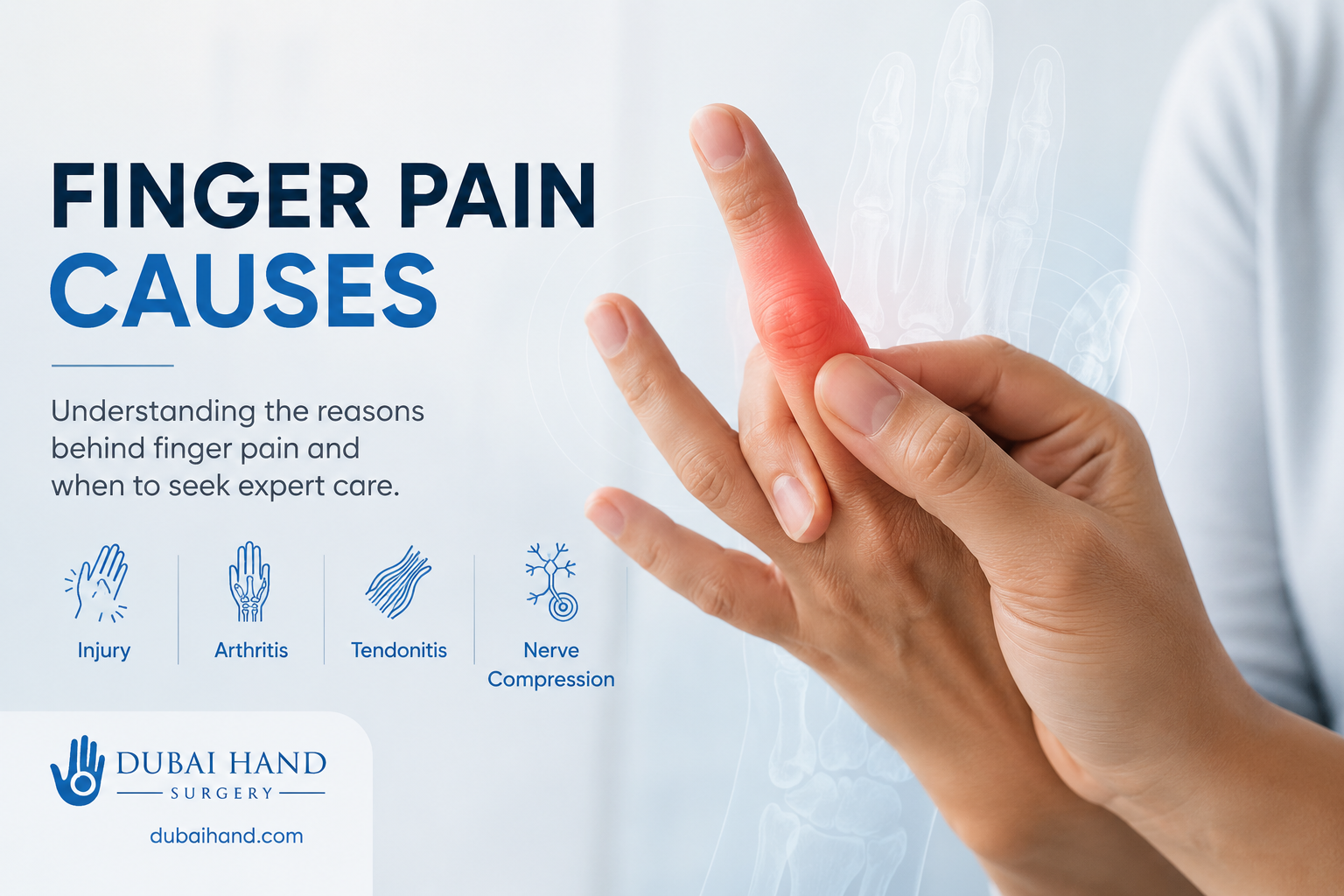
Understanding distinct finger pain causes is essential when joint stiffness, swelling, or sudden sharp discomfort interferes with your everyday hand movements. Identifying whether your discomfort stems from tendon friction, cartilage degeneration, or nerve compression ensures timely recovery. Early diagnosis prevents long-term joint stiffness and protects overall hand function. This guide also covers diagnosis, treatment options, recovery expectations, and next steps.
Key Takeaways
- Finger discomfort originates from diverse anatomical structures, including flexor pulleys, collateral ligaments, articular cartilage, and peripheral nerves.
- Distinguishing morning stiffness from acute mechanical locking helps differentiate systemic arthritis from stenosing tenosynovitis (trigger finger).
- Emergency red flags like rapid spreading redness or Kanavel signs require immediate orthopedic evaluation to prevent permanent soft tissue damage.
- Modern diagnostic approaches utilize high-resolution dynamic ultrasound to evaluate tendon gliding and ligament stability in real time.
- Targeted non-surgical interventions, including custom orthotic splinting and therapeutic injections, resolve most conditions when initiated promptly.
What Are the Primary Finger Pain Causes and Anatomical Origins?
The human hand contains 14 phalangeal bones supported by an intricate network of tendons, annular pulleys, and neurovascular bundles. Disruption to any of these delicate structures can generate severe discomfort and restrict range of motion.
Orthopedic specialists classify symptoms based on whether the underlying pathology involves bone, soft tissue, nerve signaling, or microvascular circulation. Pinpointing the exact anatomical origin is the first step toward lasting relief.
If you are experiencing unexplained discomfort, completing an interactive hand and finger pain assessment quiz can help clarify symptom patterns prior to your clinical visit.
Why Do My Finger Joints Hurt All of a Sudden?
Sudden joint discomfort without obvious trauma frequently points to acute inflammatory flares or micro-tears in stabilizing soft tissues. Common spontaneous triggers include:
- Uric acid crystal deposition: Rapid onset of severe joint pain and heat, typical of acute gout attacks.
- Tendon sheath inflammation: Acute tenosynovitis caused by repetitive pinch gripping or unaccustomed manual tasks.
- Spontaneous pulley sprains: Micro-ruptures in the annular pulley system during high-load resistance activities.
How Traumatic Injuries Influence Finger Pain Causes
Trauma to the digits ranges from simple hyper-extension sprains to complex intra-articular fractures. When an athletic ball strikes the extended fingertip, it often avulses the terminal extensor tendon, creating a mallet deformity.
Seeking targeted clinical mallet finger treatment in Dubai ensures the tendon reattaches properly under strict continuous immobilization protocols, as detailed by the American Academy of Orthopaedic Surgeons (AAOS).
Traumatic and Mechanical Finger Injuries
Mechanical injuries occur when external loads exceed the physiological tolerance of the finger’s bones and stabilizing ligaments. These conditions require accurate physical examination and radiographic assessment.
What Does a Jammed Finger Actually Mean?
A “jammed finger” is a colloquial term for an axial impact injury that compresses the proximal interphalangeal (PIP) or distal interphalangeal (DIP) joint. This impact can cause:
- Collateral ligament partial tears, leading to lateral joint instability and localized bruising.
- Volar plate avulsions, where the fibrocartilaginous reinforcement on the palm side pulls away from the bone.
- Intra-articular fractures that disrupt smooth cartilage gliding surfaces.
I jammed my finger weeks ago and it’s still swollen and stiff—is this normal?
Lingering swelling after a finger sprain is common because the digital capsule has limited lymphatic drainage. However, persistent stiffness beyond four weeks may indicate an unrecognized ligament tear, fixed joint contracture, or chronic volar plate instability that requires clinical splinting.
Phalangeal Fractures and Joint Dislocations
Fractures of the proximal, middle, or distal phalanges present with immediate swelling, rotational deformity, and localized bone tenderness. A finger that overlaps adjacent digits when making a partial fist indicates malrotation.
Unstable fractures require precise anatomic reduction to avoid permanent functional deficits. Complex injuries may require surgical stabilization, which is explained during a comprehensive evaluation of your finger pain causes with an orthopedic specialist.
Tendon and Synovial Pathologies: Trigger Finger and Tendonitis
Tendons transmit power from forearm muscles to the fingertips, gliding through lubricated synovial sheaths held close to bone by fibrous pulleys. When inflammation narrows these tunnels, mechanical catching occurs.
Stenosing Tenosynovitis (Trigger Finger)
Trigger finger develops when the A1 pulley thickens, constricting the flexor digitorum tendons. Patients experience a painful click or complete mechanical locking when opening or closing the hand, particularly upon waking.
Why does my middle finger snap and hurt when I try to straighten it in the morning?
This morning snapping sensation is the classic sign of stenosing tenosynovitis. Synovial fluid pools within the tendon sheath during sleep, swelling the tendon nodule so it catches firmly behind the A1 pulley until manually forced straight.
Arthritic and Joint-Related Finger Pain
Arthritis is one of the most widespread chronic finger pain causes worldwide. Differentiating degenerative wear from systemic inflammatory disease is critical for selecting the correct therapeutic path.
| Clinical Feature | Osteoarthritis (Wear & Tear) | Rheumatoid Arthritis (Inflammatory) | Gout (Crystal Arthropathy) |
| Primary Joint Involvement | DIP joints, PIP joints, thumb basal CMC joint | MCP joints, PIP joints, wrist symmetrically | Typically monoarticular; sudden MCP or PIP flares |
| Morning Stiffness Duration | Brief, usually resolving in under 30 minutes | Prolonged, persisting over 60 minutes | Variable; joint remains acutely tender all day |
| Characteristic Physical Signs | Hard bony spurs (Heberden and Bouchard nodes) | Soft, boggy synovial swelling, ulnar drift | Erythema, intense heat, skin desquamation, tophi |
| Underlying Pathology | Cartilage breakdown and subchondral bone remodeling | Autoimmune synovial pannus destruction | Monosodium urate crystal inflammatory response |
Research published by the National Institute of Arthritis and Musculoskeletal and Skin Diseases (NIAMS) confirms that early joint-protective strategies slow cartilage degeneration in both forms of chronic arthritis.
Heberden and Bouchard Nodes in Osteoarthritis
As cartilage thins within interphalangeal joints, reactive bone spurs (osteophytes) enlarge. Heberden nodes form at the terminal DIP joints near the fingernails, whereas Bouchard nodes appear at the middle PIP joints. While initially tender, these bony enlargements often become painless over time, leaving mild angular deformities.
Nerve Compression and Radiating Neuropathic Pain
Pain felt in the fingers does not always originate within the digits themselves. Compression along the median, ulnar, or cervical nerve roots often radiates distal pain, burning, and sensory changes.
Carpal Tunnel Syndrome and Digital Paresthesia
Median nerve compression at the wrist produces nocturnal tingling, numbness, and aching across the thumb, index, middle, and radial half of the ring finger. When conservative bracing fails, patients may benefit from nerve decompression for carpal tunnel syndrome UAE to prevent permanent muscle atrophy.
My pinky and ring finger are throbbing and numb—is this coming from my elbow or hand?
Numbness and throbbing localized specifically to the small finger and ulnar side of the ring finger usually indicate ulnar nerve irritation at the elbow (cubital tunnel syndrome). Flexing the elbow for prolonged periods increases nerve tension, producing distal finger discomfort.
Infections, Vascular Disorders, and Rare Conditions
Non-mechanical conditions require swift identification to prevent serious soft tissue complications or vascular compromise.
Infectious Flexor Tenosynovitis and Kanavel’s Four Cardinal Signs
Infectious tenosynovitis is a surgical emergency where bacteria enter the closed flexor sheath via a puncture or scratch. Hand surgeons evaluate this using Kanavel’s four cardinal signs:
- Symmetrical, uniform sausage-like swelling along the entire digit.
- The affected finger is held in slight passive flexion at rest.
- Exquisite tenderness along the entire anatomical course of the flexor tendon sheath.
- Severe, sharp pain elicited upon passive extension of the finger.
Raynaud’s Phenomenon and Cold Sensitivity
Raynaud’s phenomenon causes digital vasospasms in response to cold temperatures or emotional stress. Fingers turn starkly white, then cyanotic blue, before throbbing and turning red as blood flow returns.
Glomus Tumors and Subungual Pain
A glomus tumor is a rare, benign vascular neoplasm located beneath the fingernail bed. It presents with severe localized throbbing, extreme hypersensitivity to cold water, and pinpoint tenderness under the nail plate.
Symptom-Location Diagnostic Matrix
To help categorize clinical presentations, the matrix below connects symptom locations with likely diagnoses and next steps:
| Pain Location | Primary Sensation | Aggravating Factor | Most Likely Condition |
| DIP Joint (Fingertip) | Dull ache, stiffness, bony enlargement | Pinch gripping, writing, cold weather | Distal Osteoarthritis (Heberden Nodes) |
| PIP Joint (Middle Joint) | Lateral joint line tenderness, swelling | Side-to-side stress, opening tight jars | Collateral Ligament Sprain or Volar Plate Tear |
| A1 Pulley (Base of Finger/Palm) | Tender nodule, catching or locking | Straightening finger after fist formation | Stenosing Tenosynovitis (Trigger Finger) |
| Palmar Distal Phalanx | Intense throbbing, erythema, tense skin | Direct pressure or lowering hand below heart | Digital Pulp Abscess (Felon) |
| Thumb, Index, Middle Digits | Tingling, burning, nocturnal numbness | Prolonged keyboard typing or wrist flexion | Median Nerve Compression (Carpal Tunnel) |
Freshness Update: Modern Diagnostic Modalities and Clinical Care Protocols
Diagnostic protocols for upper limb conditions continue to advance. Clinical hand surgery practices now rely heavily on point-of-care high-resolution ultrasound (HRUS) during initial physical exams.
Dynamic ultrasound enables real-time visualization of flexor tendon subluxation, annular pulley thickening, and occult soft-tissue glomus lesions without requiring ionizing radiation. Furthermore, targeted guided hand and wrist injections for pain provide accurate relief under direct ultrasound guidance, improving precision while minimizing discomfort.
When to See a Hand Surgeon: Critical Red Flags
While many minor finger strains resolve with rest, certain clinical signs require immediate evaluation by a specialist:
- Presence of any Kanavel sign (especially extreme pain on passive finger extension).
- Visible angular deformity or rotational overlap when flexing the digits.
- Progressive numbness, loss of two-point discrimination, or cyanotic color changes.
- Persistent joint locking that cannot be passively straightened without severe pain.
- Deep puncture wounds near tendon sheaths showing rapidly spreading redness.
Frequently Asked Questions About finger pain causes
What causes pain in the fingers of the hand?
Discomfort in the fingers results from traumatic ligament sprains, tendon sheath inflammation like trigger finger, degenerative osteoarthritis, systemic inflammatory diseases such as rheumatoid arthritis, peripheral nerve entrapment, or localized soft tissue infections.
What does arthritis in fingers feel like?
Arthritis in the fingers feels like deep, persistent aching within the joints, accompanied by stiffness, localized swelling, reduced grip strength, and the gradual development of firm bony enlargements at the middle or end joints.
When should I be worried about finger pain?
You should seek prompt medical evaluation if you notice sudden rotational deformity, rapidly spreading warmth and redness, severe throbbing after a puncture wound, constant numbness, or inability to straighten a locked digit.
Why do my finger joints hurt all of a sudden without an injury?
Sudden joint discomfort without trauma typically indicates an acute inflammatory condition such as gout, a rheumatoid arthritis flare, acute flexor tenosynovitis, or microvascular spasms associated with cold exposure. In practice, patients should confirm the diagnosis, compare suitable treatment options, understand recovery timing, and ask when specialist hand or wrist assessment is needed.
Can typing all day cause sharp joint pain in my index finger?
Yes, repetitive high-frequency typing can lead to microtrauma of the flexor tendon pulleys and intrinsic muscles. Sustained biomechanical strain causes localized tenosynovitis and joint irritation that improves with ergonomic modification and rest.
Why does only one finger hurt when bending it?
Single-digit pain during bending is usually mechanical rather than systemic, pointing to localized conditions such as an isolated trigger finger nodule, a collateral ligament strain, or a focal volar plate injury.
Resources and Further Reading
- American Academy of Orthopaedic Surgeons (AAOS): Clinical reference library on finger fractures, mallet finger injuries, and osteoarthritis care.
- National Institute of Arthritis and Musculoskeletal and Skin Diseases (NIAMS): Comprehensive evidence-based resources detailing degenerative and autoimmune joint conditions.
- Johns Hopkins Medicine Hand Conditions Guide: Diagnostic overviews and non-surgical management pathways for upper extremity disorders.
Grounding Sources
- [1] American Academy of Orthopaedic Surgeons (AAOS)
- [2] National Institute of Arthritis and Musculoskeletal and Skin Diseases (NIAMS)
- [3] Johns Hopkins Medicine Hand Conditions Guide
Conclusion
Understanding the full spectrum of finger pain causes allows you to distinguish temporary muscular fatigue from serious structural injuries or chronic joint conditions. Accurate early diagnosis by an orthopedic specialist ensures targeted care, preserves delicate joint biomechanics, and restores pain-free hand function.
Ready to Take the Next Step?
If persistent finger stiffness, locking, or joint aching is affecting your daily comfort and grip strength, do not wait for symptoms to worsen. Patients across Dubai and the UAE can schedule your consultation with our hand team to receive a comprehensive diagnostic evaluation and a personalized treatment plan from Dr. Mohammad Ali.
A focused consultation for finger pain causes can help identify the cause of your symptoms and the safest path back to comfortable hand and wrist function. Book a Dubai Hand consultation to review your symptoms, imaging needs, and safest treatment options.