
Gym injury elbow hyperextension Dubai: Triage, Care & Rehab Guide
Dealing with a gym injury elbow hyperextension dubai lifters encounter can immediately halt your training momentum in the gym. When high-velocity forces...
 Written by
Dr Mohammad Ali
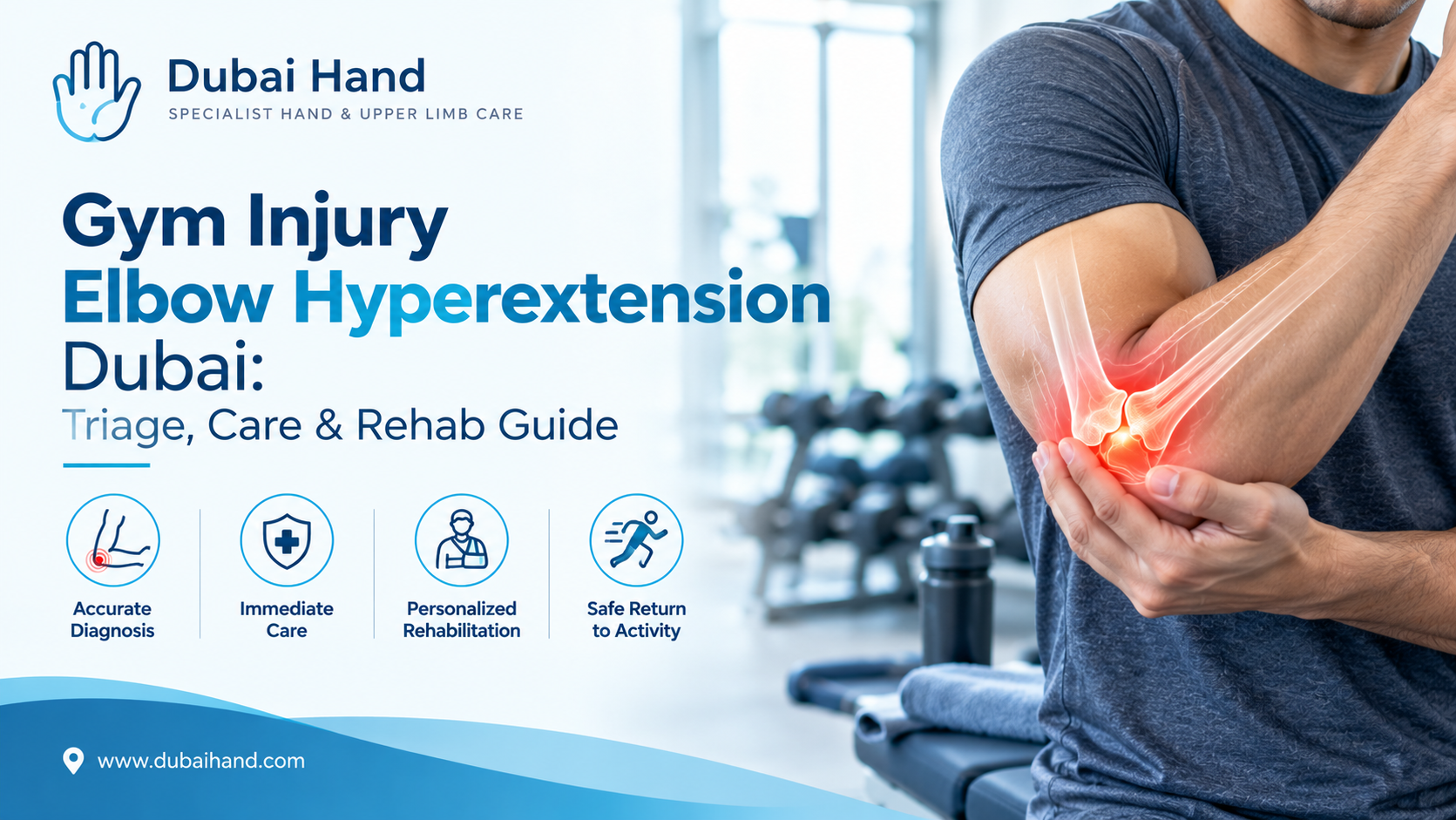
Dealing with a gym injury elbow hyperextension dubai lifters encounter can immediately halt your training momentum in the gym. When high-velocity forces drive your joint beyond normal anatomical limits, anterior tissues tear and posterior bones impact. Getting an early, accurate clinical diagnosis protects long-term joint health and supports your safe return to resistance training.
Key Takeaways
- Elbow hyperextension under load stretches the anterior capsule and impinges the posterior olecranon process against the olecranon fossa.
- Acute care has transitioned from the traditional RICE method to the contemporary PEACE & LOVE rehabilitation paradigm.
- Mechanical joint locking, rapid intra-articular swelling, or medial instability require high-field diagnostic imaging to rule out avulsion fractures and ligament tears.
- A progressive reload model enables lifters to rebuild stabilizing tendon stiffness before returning to heavy bench lockouts.
The Anatomy of an Elbow Hyperextension: What Happens During a Heavy Gym Lift
The elbow is fundamentally a trochleoginglymoid joint, which means a hinge-and-pivot joint designed to bend, straighten, and rotate the forearm smoothly. It gains structural integrity from both static bony contours and dynamic muscular restraints.
In standard anatomical alignment, full extension terminates at roughly 0 degrees, stabilized as the olecranon process, which means the bony tip of your elbow, settles neatly into the posterior olecranon fossa. Natural soft tissue elasticity permits up to 5 degrees of extension in healthy individuals.
When an aggressive downward load drives the forearm backwards beyond zero degrees, mechanical failure initiates across distinct tissue planes.
What Happens to the Anterior Capsule and Flexor Muscles?
The anterior joint capsule, which means the strong fibrous sac enclosing the front of the joint, acts as the primary soft-tissue restraint preventing backward bending during terminal joint extension. Under high-velocity gym loads, this fibrous sheet sustains significant tensile distraction.
Directly overlying the capsule, the brachialis and biceps brachii muscles contract eccentrically to arrest the backward motion. Clinical evaluations often show that severe force creates micro-tearing in these deep anterior muscle bellies alongside capsular sprains, documented in PubMed Central studies on athletic hyperextension patterns.
How Does Posterior Bony Impingement Cause Kissing Lesions?
While anterior structures stretch, posterior structures experience compressive forces. The tip of the ulna slams directly into the humeral bone surface.
This violent contact creates subchondral bone bruises, often referred to by surgeons as “kissing contusions.” In high-impact cases, these forces can fracture the fragile margins of the olecranon tip or shed micro-fragments of articular cartilage into the joint cavity.
Common Gym Triggers: From Bench Press Lockouts to Calisthenics
Hyperextension rarely occurs in isolation during strength training. It typically results from rapid bar deceleration, technical fatigue, or uncontrolled catches under heavy barbells.
Why Does the Bench Press Cause Acute Hyperextension?
During maximum or near-maximum bench pressing, lifters frequently snap their arms into hard lockout to secure the repetition. If the barbell drifts backward past the vertical plane of the shoulders, the load produces an acute extension moment.
When wrist stability breaks down simultaneously, the mechanical axis shifts, forcing the humeroulnar joint open anteriorly. Athletes experiencing residual shoulder fatigue during these movements can review our guide on shoulder pain after gym training to identify compensatory lifting flaws.
Olympic Weightlifting Catches: The Snatch and Clean & Jerk
Receiving a heavy barbell overhead requires instantaneous structural stabilization. A missed catch during a snatch can drop the bar slightly behind the center of mass, violently pushing the elbow into hyperextension under dynamic loads exceeding body weight.
Calisthenics, Dips, and Combat Sports
Weighted dips present substantial risk when lifters drop rapidly into the eccentric bottom or violently jerk into extension at the top. Bodyweight calisthenics on gymnastic rings introduce multidirectional instability, multiplying mechanical torque across the medial ligaments.
In mixed martial arts and Brazilian Jiu-Jitsu, straight armbar submissions force the joint past physiological limits. If the athlete delays tapping, severe joint trauma quickly follows.
Clinical Signs and Injury Grading: Assessing the Damage
Accurate clinical triaging determines whether your injury requires conservative physiotherapy or immediate surgical intervention. A traumatic gym injury elbow hyperextension dubai athletes sustain generally falls into three discrete severity grades.
| Injury Grade | Structural Involvement | Clinical Symptoms | Typical Recovery Time |
|---|---|---|---|
| Grade I (Mild) | Microscopic stretching of anterior capsule; no joint laxity. | Mild anterior tenderness, localized swelling, pain at full extension. | 1 to 3 weeks |
| Grade II (Moderate) | Partial tearing of anterior capsule; possible minor sprain of the ulnar collateral ligament (UCL). | Moderate diffuse edema, visible ecchymosis, distinct weakness during flexion, pain at rest. | 4 to 8 weeks |
| Grade III (Severe) | Complete capsular rupture, full UCL tear, potential posterior dislocation or avulsion fracture. | Immediate deformity, severe instability, inability to resist valgus stress, neurovascular tingling. | 3 to 6+ months (may require surgery) |
Recognizing a gym injury elbow hyperextension dubai When Symptoms Turn Severe
Athletes frequently ask how to identify when joint trauma has crossed beyond simple soreness. Key indicators of severe trauma include an audible popping sound, rapid intra-articular swelling appearing within two hours, and numbness radiating into the pinky or ring finger.
If the joint feels completely loose or physically blocks you from bending past 90 degrees, structural integrity has been compromised. Conservative care guidelines outlined by MedlinePlus on elbow sprains and strains emphasize that mechanical blocking warrants emergency diagnostic imaging.
Can You Lift Weights With a Hyperextended Elbow?
Continuing to lift through acute hyperextension pain converts a manageable ligament sprain into chronic instability. Axial loading across an unstable joint accelerates cartilage wear, predisposing the lifter to premature degenerative changes.
All compound upper-body pressing and pulling movements must cease immediately while acute tissue repair takes place. Patients seeking a structured clinical assessment can schedule a first visit to an orthopedic doctor in the UAE to establish baseline joint stability.
Modern Soft-Tissue Management: The PEACE & LOVE Protocol
For decades, fitness communities relied exclusively on the traditional RICE (Rest, Ice, Compression, Elevation) regimen. Contemporary sports medicine has retired this concept, recognizing that aggressive icing and prolonged immobilization delay soft tissue healing.
Why Has the Medical Community Moved Away From RICE?
Research confirms that immediate, excessive cold application blunts natural inflammatory signaling pathways needed for cellular repair. Non-steroidal anti-inflammatory drugs (NSAIDs) also impair collagen synthesis during the initial 72 hours of tendon and ligament healing.
The Acute Phase: Treat With PEACE
- Protect: Unload the joint immediately. Limit movement for the first 48 to 72 hours to minimize bleeding without completely encasing the arm in rigid casts unless a fracture is present.
- Raise the Limb: Keep the joint supported above heart level whenever seated or resting to promote interstitial fluid drainage and reduce swelling.
- Avoid Anti-Inflammatory Modalities: Refrain from popping high-dose ibuprofen or applying ice baths, which inhibit tissue regeneration.
- Compress: Apply a supportive elastic bandage or cohesive wrap to minimize localized swelling.
- Educate: Understand that active recovery yields better clinical outcomes than passive bed rest.
The Subacute Phase: Rebuild With LOVE
- Load: Introduce gentle, pain-free active movement as early as symptoms allow. Mechanical loading stimulates collagen fiber realignment.
- Optimism: Maintain a constructive mindset; psychological confidence directly influences central pain processing during rehabilitation.
- Vascularization: Engage in pain-free cardiovascular activity (such as a stationary bike) to boost systemic blood flow to healing tissues.
- Exercise: Progressively restore full range of motion, motor control, and joint stabilization strength.
Freshness Update: Modern Advancements in Upper Limb Sports Medicine
Clinical standards for managing acute athletic joint trauma in elite sporting hubs like Dubai have evolved substantially[1]. Fellowship-trained upper limb specialists now rely on high-resolution 3-Tesla MRI protocols that clearly visualize capsular disruptions without requiring invasive contrast dyes[1] [2] [3].
Furthermore, early dynamic ultrasound is increasingly performed chairside during your initial consultation. This allows surgeons to assess valgus stress, which means side-to-side joint stability, in real time, confirming whether ligamentous laxity exists under active muscular guarding.
For athletes seeking accelerated biological tissue healing, advanced cellular therapies—including high-concentration platelet-rich plasma (PRP)—are applied under ultrasound guidance to augment natural ligament remodeling. Lifters exploring evidence-based regenerative care can learn more about biological repair and PRP options available locally.
When to See an Orthopedic Specialist in Dubai for a gym injury elbow hyperextension dubai
Not every gym sprain requires surgery, but missing an internal ligament tear can cause chronic joint laxity. A timely evaluation by an upper limb surgeon ensures that subtle instability patterns are caught before secondary arthritis develops.
Red Flag Symptoms Requiring Immediate Orthopedic Evaluation
- Gross angular deformity of the humeroulnar joint.
- Sensation of the joint slipping out of place during basic daily activities.
- Severe, throbbing nighttime pain that prevents uninterrupted sleep.
- Progressive tingling, pins-and-needles, or loss of grip strength in the hand.
- Inability to pronate or supinate the forearm without sharp catching sensations.
Lifters needing an immediate clinical opinion can arrange to book an in-person orthopedic consultation in Dubai to undergo comprehensive physical stress testing.
Diagnostic Imaging: X-Ray vs. MRI
Plain digital radiographs (X-rays) are essential immediately following the injury to exclude avulsion fractures, coronoid process fractures, and loose joint bodies. However, X-rays cannot evaluate soft tissue.
A non-contrast 3T MRI is the gold standard for visualizing the anterior capsular integrity, the flexor-pronator mass origin, and the anterior bundle of the ulnar collateral ligament, as demonstrated in clinical trials indexed on PubMed Central regarding elbow hyperextension staging.
Rehabilitation and Safe Return-to-Lifting Timeline
Rehabilitating from an acute gym injury elbow hyperextension dubai lifters encounter requires disciplined progressive overloading. Rushing back to heavy compound pressing prematurely risks re-rupturing nascent collagen scaffolds.
Phase 1: Controlled Mobility and Isometric Activation (Weeks 1 to 2)
The goal is restoring passive and active flexion while guarding terminal extension. Perform pain-free wrist flexor and extensor isometric holds against gentle hand resistance.
Incorporate submaximal biceps and triceps co-contractions at 90 degrees of flexion. At no point during this phase should the joint be forced into painful terminal extension.
Phase 2: Dynamic Loading and Kinetic Chain Integration (Weeks 3 to 6)
Gradually reintroduce light dumbbell hammer curls and cable triceps pressdowns using high repetitions and controlled cadences. Focus heavily on eccentric control.
Integrate rotator cuff stabilization and scapular retractor conditioning to ensure the shoulder complex absorbs axial forces during future compound pressing. For persistent mechanical catching or unresolved pain, explore advanced interventions through elbow arthroscopy procedures.
Phase 3: Sport-Specific Strength and Return-to-Bench Progression (Weeks 6+)
Before re-racking a heavy barbell, lifters must satisfy objective functional criteria. Comprehensive protocols documented in PubMed Central research on athletic ligament rehabilitation highlight the importance of neuromuscular stability drills before return to play.
The Return-to-Pressing Checklist
- Full active elbow flexion and extension matching the uninjured arm without sharp discomfort.
- Bilateral grip strength parity verified via dynamometer testing.
- Negative provocative valgus stress test and moving valgus stress test.
- Ability to perform 20 strict push-ups without anterior joint apprehension.
- Completion of progressive floor-press sessions before attempting deep-range benching.
Navigating UAE Health Insurance and Specialist Care in Dubai
Navigating private healthcare in the UAE involves clear procedural pathways. Most expatriates and residents carry corporate health insurance policies issued through networks such as Daman, NextCare, AXA/GIG, MetLife, or Bupa.
Securing Insurance Pre-Approvals for Advanced Imaging
Under Dubai Health Authority (DHA) frameworks, diagnostic MRIs require documented clinical justification. Your orthopedic surgeon will perform physical stress assessments and record specific functional deficits during your examination.
Once submitted, insurance approvals for high-resolution MRI scans in Dubai typically process within 24 to 48 hours for standard tiers, or within hours for priority networks. When structural repairs are necessary, direct coordination with a dedicated surgical team ensures seamless pre-authorization for surgical interventions.
Choosing a Fellowship-Trained Upper Limb Specialist
While general orthopedic clinics treat broad bone fractures, complex joint trauma requires dedicated upper limb expertise. A fellowship-trained specialist possesses subspecialized knowledge in delicate ligamentous reconstructions, capsular balance, and sports-specific biomechanics.
Reviewing verifiable credentials, international surgical fellowships, and published academic outcomes ensures you receive premier care tailored to athletic performance.
Frequently Asked Questions About gym injury elbow hyperextension dubai
What happens when your elbow hyperextends at the gym?
When the joint hyperextends under gym loads, the anterior joint capsule and brachialis muscle stretch violently, while the olecranon process slams into the posterior fossa. This mechanism frequently causes capsular tearing, bone bruising, and potential strain to the ulnar collateral ligament.
How long does an elbow hyperextension take to heal?
Mild Grade I hyperextension sprains typically heal within 1 to 3 weeks with proper loading. Moderate Grade II partial tears require 4 to 8 weeks of rehabilitation, while severe Grade III ruptures or dislocations may require 3 to 6 months of comprehensive care.
Why did my elbow make a popping sound during a bench press?
A loud pop during heavy pressing usually indicates sudden mechanical failure. This occurs when the anterior joint capsule tears, an avulsion fracture detaches, or the medial ulnar collateral ligament suffers structural compromise under intense valgus and extension torque.
Can I do pull-ups with a hyperextended elbow?
Pull-ups place significant tensile stress across the anterior elbow joint, brachialis, and biceps tendons. You should avoid pull-ups during the acute healing phase, reintroducing them only when pain-free bodyweight hanging and full isometric flexion strength are restored.
Is ice or heat better for an acute elbow gym injury?
Contemporary medical evidence advises avoiding ice during the initial 72 hours, as excessive cold blunts the natural cellular healing cascade. Mild compression and protected mobilization are preferred; gentle heat may be applied later to relax surrounding hypertonic musculature.
Will wearing an elbow brace help me bench press again safely?
A specialized hyperextension brace with an adjustable extension stop can physically prevent the arm from locking out past safe angles during early rehabilitation. However, braces should complement active muscular stabilization rather than serve as a permanent crutch for poor lifting mechanics.
Resources and Further Reading
- PubMed Central (PMC7727421): Nonoperative rehabilitation and biomechanical staging of traumatic complete ulnar collateral ligament and anterior capsule tears caused by elbow hyperextension.
- PubMed Central (PMC5608741): Clinical analysis of the pattern and mechanism of medial elbow and capsule injuries sustained under forced hyperextension loads in athletic training.
- PubMed Central (PMC4832224): Evidence-based management, bracing protocols, and return-to-sport progression for athlete elbow ligament disruptions.
- MedlinePlus (U.S. National Library of Medicine): Official medical guidance on elbow sprains, soft tissue strains, self-care, and clinical red-flag indicators.
Grounding Sources
- [2] rsna.org
- [3] nih.gov
- [4] PubMed Central studies on athletic hyperextension patterns
- [5] MedlinePlus on elbow sprains and strains
- [6] PubMed Central regarding elbow hyperextension staging
Conclusion
Navigating a gym injury elbow hyperextension dubai athletes face demands an evidence-based approach that respects biological tissue healing. By moving past obsolete icing regimens, respecting modern PEACE & LOVE protocols, and obtaining accurate 3T MRI diagnostics when red flags arise, lifters can protect their joint cartilage and rebuild structural stability. With disciplined rehabilitation and progressive reloading, a return to full pressing strength is entirely achievable.
Dr. Mohammad Ali, Fellowship-Trained Hand, Wrist and Upper Limb Surgeon, contributed this guest article. Read more from Dr. Mohammad Ali.
Ready to Take the Next Step?
Whether you are dealing with lingering joint instability or an acute gym injury elbow hyperextension dubai lifters experience, getting timely expert support makes all the difference. Dr. Usama Saleh provides comprehensive diagnostics, advanced sports injury solutions, and personalized rehabilitation plans tailored to active professionals and athletes across the UAE. If you are experiencing joint pain, popping, or weakness after a heavy lift, contact Dr. Usama Saleh today to arrange your specialized orthopedic consultation.