
Ganglion Cyst Wrist: Diagnosis, Causes, and Advanced Removal
Clinically authored by Dr. Mohammad Ali, Fellowship-Trained Hand, Wrist and Upper Limb Surgeon in Dubai, UAE. A ganglion cyst wrist is the...
 Written by
Dr Mohammad Ali
Clinically authored by Dr. Mohammad Ali, Fellowship-Trained Hand, Wrist and Upper Limb Surgeon in Dubai, UAE.
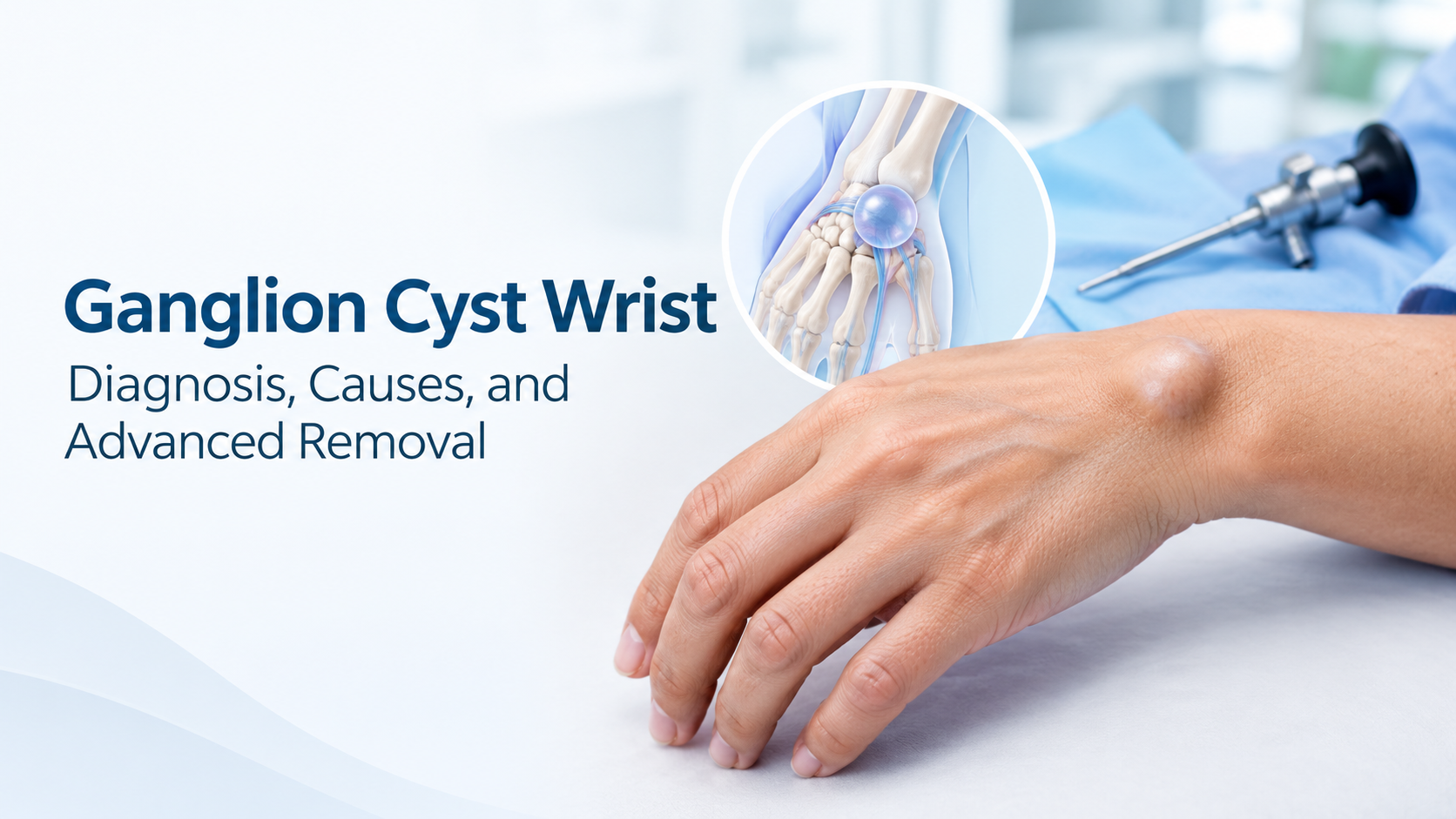
A ganglion cyst wrist is the most common benign soft-tissue swelling found in the hand and wrist. Developing along joint capsules or tendon sheaths, these fluid-filled sacs often fluctuate in size and cause localized discomfort or nerve irritation. Understanding accurate anatomical origins, needle aspiration recurrence realities, and modern minimally invasive surgical options ensures you choose the most effective, lasting treatment path.
Key Takeaways
- Ganglion cysts are non-cancerous, mucin-filled lumps arising from joint capsules or tendon sheaths, most frequently over the scapholunate ligament on the back of the wrist.
- Modern wrist arthroscopy provides complete capsular stalk debridement with smaller incisions and faster return to active hand motion.
- Striking a cyst with heavy objects is dangerous and risks bone fractures, soft-tissue damage, and joint infections.
What Is a Ganglion Cyst Wrist and Why Does It Form?
A ganglion cyst wrist represents a smooth, firm, fluid-filled swelling that emerges adjacent to a carpal joint or tendon sheath.
These lumps are entirely benign and cannot turn into malignant tumors.
Inside the sac is a thick, clear, gelatinous fluid high in hyaluronic acid, glucosamine, and albumin, resembling condensed synovial fluid, which means the natural lubricating liquid found inside normal joints.
Anatomy of the Joint Capsule and Mucin Fluid
The cyst forms when joint stress or micro-trauma causes capsular tissue to stretch or degenerate.
This process creates a narrow stalk or pedicle, which means a small connecting stem, linking the joint space to the cyst.
The stalk functions like a one-way check valve, allowing joint fluid into the cyst sac while preventing it from flowing back into the joint capsule.
Dorsal Ganglion Cyst Wrist vs. Volar Ganglion Cyst Wrist
The location of the lump dictates both the surgical approach and the anatomical structures requiring protection.
| Anatomical Feature | Dorsal Wrist Ganglion | Volar Wrist Ganglion |
| Prevalence | 60% – 70% of all wrist ganglia | 18% – 20% of all wrist ganglia |
| Typical Origin | Scapholunate ligament and capsule | Radiocarpal joint or STT joint capsule |
| Visible Location | Back of the wrist, prominent with flexion | Palmar wrist crease near the thumb base |
| Adjacent Structures | Extensor digitorum communis tendons | Radial artery, palmar cutaneous nerve |
| Transillumination | Readily transilluminates with light | Transilluminates (requires vascular check) |
Dorsal cysts become noticeably prominent when bending the wrist downward.
Volar cysts sit adjacent to the radial pulse, requiring meticulous care to safeguard blood vessels during intervention.
What Causes a Ganglion Cyst Wrist to Suddenly Appear?
A ganglion cyst wrist often appears without a single identifiable traumatic event.
However, repetitive loading, ligament laxity, and micro-tears in the joint capsule create favorable conditions for cyst progression.
Patients engaged in gymnastics, weightlifting, racquet sports, or intensive manual work show higher rates of symptomatic capsular swelling.
Repetitive Wrist Strain and Capsular Weakness
Repetitive extension and flexion generate micro-tears in stabilizing wrist ligaments.
The body responds by producing extra mucin fluid to protect the joint.
As internal joint pressure increases, this fluid herniates through weak capsular fibers to form a distinct subcutaneous pocket, which means a fluid pocket sitting just beneath the skin.
Why Does My Wrist Ganglion Fluctuate in Size?
Patients frequently ask why their wrist bump seems larger after busy workdays and smaller after resting.
The one-way valve stalk pumps more fluid into the cyst whenever joint motion increases internal carpal pressure.
During periods of wrist rest or immobilization, fluid production slows down and water content is gradually absorbed by surrounding tissues.
Symptoms and Differential Diagnosis for Lumps on the Wrist
While many cysts cause no pain, others produce distinct functional limitations depending on size and nerve involvement.
Patients who require comprehensive clinical evaluation for chronic wrist pain treatment often present with aching during loaded wrist extension.
Ganglion Cyst Wrist Pain and Nerve Tingling
Discomfort from a ganglion cyst wrist stems from two primary mechanisms:
- Mechanical Impingement: Pain during deep push-ups or heavy lifting when the cyst compresses against extensor retinaculum bands.
- Nerve Compression: A volar cyst pressing on the median nerve can mimic carpal tunnel syndrome, while compression on the ulnar nerve creates ring-finger tingling.
- Occult Ganglia: Small, hidden cysts deep inside the joint that do not present a visible lump but cause persistent wrist ache during sports.
How Do I Know If My Wrist Lump Is a Ganglion Cyst or a Tumor?
Patients naturally worry about malignancy when discovering a sudden subcutaneous mass.
True soft-tissue sarcomas in the wrist are exceptionally rare and typically feel hard, fixed to deep tissues, and completely non-translucent.
Other non-cancerous lumps that can appear around the wrist include:
- Giant Cell Tumor of the Tendon Sheath: Solid, firm, non-tender, and does not transmit light.
- Carpal Boss: A bony, hard, immovable spur at the base of the second or third metacarpal.
- Epidermoid Cysts and Lipomas: Soft fatty or sebaceous skin deposits that do not connect to the joint space.
- Rheumatoid Nodules: Inflammatory deposits associated with systemic arthritis.
Clinical Diagnostic Tests: Transillumination, Allen’s Test, and Ultrasound
Accurate diagnosis involves three key clinical and imaging steps:
1. Transillumination Test: In a darkened room, a penlight placed against the mass reveals whether light passes clearly through mucin fluid, which means showing transillumination, the diagnostic passage of bright light through fluid-filled tissue.
2. Allen’s Vascular Patency Test: Prior to evaluating any volar cyst, the hand surgeon verifies uninterrupted arterial blood flow through both radial and ulnar arteries.
3. High-Resolution Musculoskeletal Ultrasound: Confirms the cystic, anechoic nature of the mass, maps the joint stalk, and pinpoints its exact distance from the radial artery.
Non-Surgical Treatments and Home Care Realities
Asymptomatic ganglion cysts do not require immediate procedural intervention.
Splinting and Activity Modification
When mild aching occurs during active sports or typing, conservative immobilization can calm joint irritation.
Using custom orthopedic splinting to reduce joint capsular strain limits repetitive wrist extension and decreases fluid pumping across the stalk.
Non-steroidal anti-inflammatory medications provide short-term pain relief by decreasing surrounding synovial inflammation.
Why You Should Never Hit a Ganglion Cyst with a Heavy Book
Historically termed “Bible cysts” because people struck them with heavy household books, this dangerous practice must be avoided.
Smashing the cyst creates severe risks, including:
- Carpal bone fractures and scapholunate ligament tears.
- Laceration of the radial artery or median nerve branches.
- Severe subcutaneous hematoma and deep joint space infection.
- Rapid cyst recurrence because the ruptured capsule stalk remains open.
Aspiration vs. Surgical Excision: Recurrence Rates and Long-Term Results
When a ganglion cyst wrist causes chronic aching, weakness, or aesthetic distress, clinical intervention becomes necessary.
Choosing between needle aspiration and surgical removal depends on recurrence risk tolerance, lump location, and symptom severity.
Needle Aspiration Efficacy and the 50% Recurrence Reality
Aspiration involves numbing the skin, inserting an 18-gauge needle, and drawing out the thick mucin jelly.
Because aspiration leaves the underlying capsular stalk intact, the valve continues pumping fluid back into the cavity.
Aspiration of volar wrist cysts carries added hazard due to radial artery proximity and is rarely recommended without real-time ultrasound guidance.
Comparison of Wrist Ganglion Management Strategies
| Treatment Method | Invasiveness | Recurrence Rate | Recovery Time | Primary Advantages & Limits |
| Watchful Waiting | Non-invasive | Spontaneous resolution in 30%–50% | Immediate | Low risk; suitable for painless lumps that do not interfere with function. |
| Needle Aspiration | Minimally invasive in-office | 45% – 60% recurrence | 1 – 2 days | Immediate cosmetic relief; high recurrence because the stalk remains open. |
| Open Surgical Excision | Open outpatient surgery | 5% – 10% recurrence | 2 – 4 weeks | Direct visualization; allows complete resection of cyst, stalk, and capsule rim. |
| Arthroscopic Ganglionectomy | Keyhole joint surgery | 5% – 8% recurrence | 1 – 3 weeks | Small cosmetic portals, lower stiffness, simultaneous intra-articular joint check. |
Advanced Surgical Removal: Arthroscopic vs. Open Ganglion Cyst Excision
For cysts causing persistent pain, grip weakness, or recurrent swelling after aspiration, choosing definitive surgical ganglion cyst excision for recurring wrist masses provides long-term resolution.
The definitive surgical goal is not just popping the sac, but removing the cyst wall along with its parent stalk and a small rim of joint capsule.
Modern Updates in Minimally Invasive Wrist Arthroscopy
Surgical management of dorsal wrist ganglion cysts has advanced through refined keyhole techniques.
Using minimally invasive wrist arthroscopy for capsular debridement, surgeons insert a 1.9 mm or 2.7 mm camera through standard dorsal radiocarpal and midcarpal portals.
From inside the joint, the surgeon visualizes the exact base of the cyst stalk entering the scapholunate interval.
A specialized motorized shaver resects the stalk and creates a capsular window, decompressing the cyst internally while preserving superficial skin nerves.
Protecting the Radial Artery During Volar Wrist Excision
Volar wrist ganglion surgery requires meticulous microsurgical dissection.
The cyst frequently wraps around or adheres to the radial artery wall, the flexor carpi radialis tendon, or the palmar cutaneous branch of the median nerve.
During open excision, the surgeon gently mobilizes the radial artery away from the deep capsular origin, ensuring vessel integrity while excising the stalk at the radioscaphoid or scaphotrapezial joint.
Will a Ganglion Cyst Wrist Come Back After Surgery?
When recurrence happens, it is typically caused by incomplete resection of the deep joint stalk or satellite micro-cysts developing along adjacent capsular fibers.
Clinical Practice Updates and Imaging Innovations in 2026
Clinical evaluation of wrist swellings has evolved with high-frequency dynamic ultrasound and ultra-high-resolution wrist arthroscopy. Point-of-care ultrasound now allows instant, in-office distinction between mucin-filled cysts, vascular malformations, and solid soft-tissue masses, substantially reducing unnecessary biopsies. Furthermore, refined dorsal wrist arthroscopic capsulotomy techniques allow targeted resection of the one-way valve stalk while preserving dorsal intercarpal ligament stability, leading to lower post-operative stiffness and faster functional recovery.
Post-Procedure Recovery and Rehabilitation Timeline
Recovery after wrist ganglion removal is typically smooth and predictable when guided by clear functional stages.
Following post-operative instructions ensures joint mobility is restored without compromising wound healing.
Week-by-Week Recovery Milestones
| Timeline | Clinical Focus | Permitted Hand Activities | Key Precautions |
| Days 1 – 5 | Wound protection & edema control | Active finger, thumb, and elbow motion; light computer typing | Keep dressing clean and dry; keep hand raised above heart level |
| Days 10 – 14 | Suture removal & scar massage | Light daily grooming, eating, writing, gentle wrist flexing | Avoid heavy lifting, twisting, or pushing up from chairs |
| Weeks 3 – 4 | Active wrist range of motion | Driving, moderate office work, light resistance band exercises | Avoid heavy gym weightlifting or loaded push-ups |
| Weeks 5 – 6+ | Full load-bearing & sports return | Unrestricted gym training, racquet sports, yoga, golf | Progress weight incrementally if mild stiffness persists |
Is It Normal to Have Stiffness After Wrist Ganglion Surgery?
Mild joint stiffness and localized scar tightness are normal during the first 3 to 6 weeks after surgery.
Reviewing our patient guide on managing localized swelling and stiffness after wrist surgery helps you perform daily gliding exercises safely.
Dedicated scar massage with silicone gel after suture removal softens the incision and prevents tendon adhesions.
Frequently Asked Questions About this care decision
Can a this plan go away completely on its own?
What happens if a wrist ganglion cyst is left untreated?
Leaving a painless wrist ganglion untreated poses no medical danger because the lump is benign and will never transform into cancer. However, if the cyst enlarges, it can begin compressing adjacent sensory nerves, causing aching during wrist extension, numbness in fingers, or noticeable grip weakness.
Is surgery or needle aspiration better for a this treatment option?
Why does my wrist hurt even when the ganglion cyst is small?
A small or occult ganglion cyst can generate significant pain if it sits deep inside the joint capsule, putting tension on the dorsal sensory nerve or pinching between carpal bones during wrist extension. Pain correlates with internal pressure and nerve proximity rather than external bump size.
Can I pop a ganglion cyst on my wrist with a needle at home?
No, you should never attempt to pop or drain a ganglion cyst at home. Piercing the skin introduces high risks of deep joint space infections, tissue damage, or accidental puncture of the radial artery. Safe drainage or removal must always occur under sterile clinical conditions.
How soon can I return to the gym after this care decision surgery?
Light cardio and gentle finger exercises can resume within days. Most patients return to light dumbbell exercises by weeks 3 to 4. Full load-bearing workouts, including heavy bench presses, push-ups, and racquet sports, are typically cleared between 5 and 6 weeks post-surgery.
Resources and Further Reading
- American Academy of Orthopaedic Surgeons (AAOS) – Ganglion Cyst Overview: Clinical guidelines on the pathophysiology, anatomy, and standard treatments of hand and wrist cysts.
- American Society for Surgery of the Hand (ASSH) – HandCare Guide: Evidence-based patient education covering dorsal vs. volar cyst mechanics, aspiration outcomes, and surgical recovery.
- MedlinePlus Medical Encyclopedia – Ganglion Cyst: Comprehensive patient guide on diagnostic imaging, non-surgical monitoring, and clinical indications for excision.
Grounding Sources
- [1] American Academy of Orthopaedic Surgeons (AAOS) – Ganglion Cyst Overview
- [2] American Society for Surgery of the Hand (ASSH) – HandCare Guide
- [3] MedlinePlus Medical Encyclopedia – Ganglion Cyst
Conclusion
A ganglion cyst wrist is a manageable, benign condition that responds well to tailored orthopedic care. Whether you choose clinical observation, splinting, ultrasound evaluation, or definitive arthroscopic excision, identifying the exact anatomical origin and protecting adjacent neurovascular structures typically supports the best functional outcome. Accurate diagnosis of your ganglion cyst wrist ensures complete reassurance and a rapid return to pain-free daily activities.
Ready to Take the Next Step?
If a visible ganglion cyst wrist or persistent joint pain is affecting your daily comfort, sports, or work in the UAE, expert medical assessment is available. You can schedule a personal consultation with our wrist specialist at Dubai Hand Surgery Clinic for an advanced evaluation, high-resolution ultrasound diagnosis, and tailored treatment planning. Book a Dubai Hand consultation.