
Stem Cell Injection Dubai
Arm Fracture Fixation Surgery in Dubai by Dr. Mohamed Ali
Fellowship-Trained Wrist Surgeon | DHA Licensed | Arthroscopic Ligament Repair | Upper Limb Specialist | Dubai, UAE
Dr. Mohamed Ali is a fellowship-trained hand and wrist surgeon in Dubai performing arm fracture fixation for humeral shaft fractures, proximal humerus fractures, surgical neck fractures and periprosthetic fractures around shoulder implants. Each fracture is assessed individually: the decision between functional bracing, intramedullary nailing, plate fixation and reverse shoulder arthroplasty depends on the fracture pattern, the patient's age and activity level and the presence of associated radial nerve or vascular injury. Arm fracture fixation near me in Dubai is available. No referral required.
What Is Arm Fracture Fixation?
The humerus is the single bone connecting the shoulder to the elbow. Arm fractures affect either its shaft or the proximal region beside the shoulder.
Every arm fracture fixation Dubai assessment includes full-length X-rays, radial nerve testing and CT imaging for proximal or complex fracture patterns.
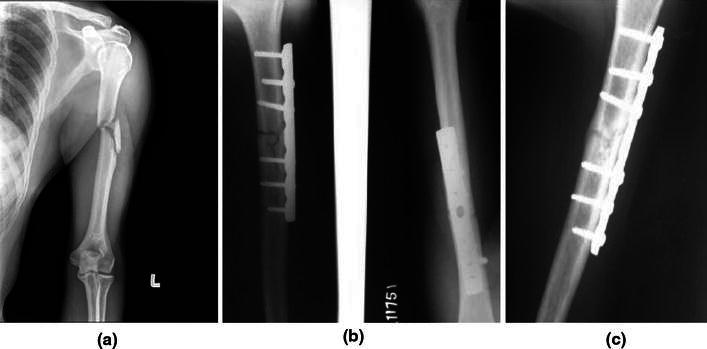
Stable shaft fractures may heal in a functional brace. Displaced, open or nerve-associated injuries may need plating or nailing, while Neer classification guides fixation or arthroplasty for proximal fractures.
Specialist fracture assessment
Types of Arm Fractures Treated in Dubai
Arm fracture fixation Dubai is planned around the fracture level, CT findings, radial nerve function and the patient's activity needs.
01
Humeral Shaft Fracture
Mid-shaft fractures may heal in a functional brace when alignment is acceptable. Displaced, open or nerve-associated injuries are stabilised with a plate or intramedullary nail.
02
Proximal Humerus Fracture, 2-Part
Displaced surgical-neck fractures in active patients may need locking-plate fixation. Greater tuberosity displacement above 5mm is treated to prevent impingement.
03
Proximal Humerus Fracture, 3-Part and 4-Part
CT defines tuberosity and head fragmentation. Locking-plate fixation suits selected active patients, while reverse shoulder arthroplasty may be safer for complex older-patient patterns.
04
Periprosthetic Humerus Fracture
CT confirms whether the shoulder or elbow implant remains stable. A fixed implant may be plated around, while a loose component requires revision and fracture fixation.
05
Open Arm Fractures
A wound communicating with the fracture needs urgent antibiotics, debridement and radial nerve protection. Stable fixation follows according to contamination and soft-tissue damage.
Complications if Arm Fractures Are Left Untreated or Inadequately Managed
Delayed diagnosis or poor alignment can compromise radial nerve function, bone healing and long-term shoulder movement.
Spiral groove risk
Radial Nerve Palsy
The radial nerve crosses the humeral shaft and may be injured at fracture or during manipulation. Persistent damage can cause wrist drop and loss of thumb extension.
Failure of bone healing
Non-union
The humeral shaft fails to heal, leaving pain, instability and reduced arm function. Revision commonly requires compression plating and bone grafting.
Humeral head collapse
Avascular Necrosis of the Humeral Head
Complex proximal fractures can disrupt blood supply to the humeral head, causing progressive collapse, pain and stiffness that may require arthroplasty.
Loss of shoulder alignment
Malunion and Shoulder Stiffness
Poor proximal-humerus alignment can cause impingement, restricted elevation and chronic pain. Late corrective surgery is more demanding and less predictable.
Specialist arm fracture fixation Dubai assessment protects nerve function, shoulder alignment and reliable bone healing.
Diagnosing Arm Fractures in Dubai
Diagnosis defines the humerus fracture pattern, checks radial nerve and circulation, and confirms whether fixation or non-operative care is safest.
Clinical Examination
The injury mechanism, swelling, bruising and deformity help define the fracture level and reveal open wounds or soft-tissue damage.
Radial Nerve Function
Wrist extension, thumb extension and dorsal-hand sensation are documented before and after every fracture intervention.
Vascular Status
Radial and brachial pulses are checked immediately. A pale or pulseless hand requires urgent vascular surgical assessment.
X-rays and CT Planning
Two-plane X-rays assess every suspected fracture. CT is essential for proximal, periprosthetic and complex multi-fragment patterns.
Specialist review before fixation Dr. Mohamed Ali reviews the imaging and radial nerve findings before finalising every arm fracture fixation Dubai plan. Direct booking is available without a referral.
Surgical Fixation Techniques for Arm Fractures in Dubai
The technique is selected from the fracture level, CT findings, radial nerve status, bone quality and the patient's functional needs.
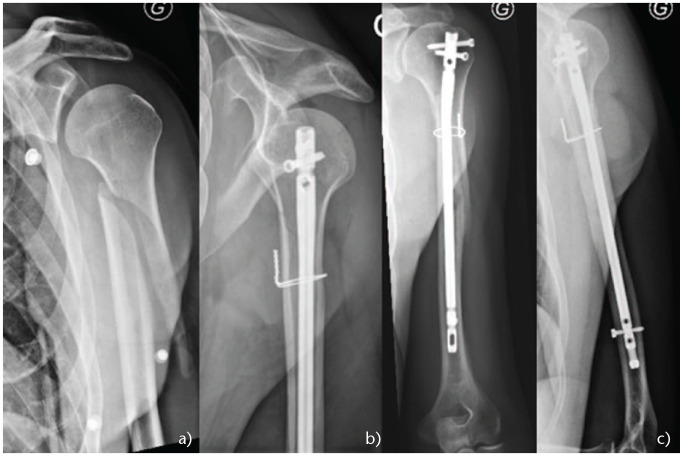
Intramedullary Nailing
A locked nail spans the humeral canal to control length and rotation. This load-sharing construct supports early shoulder and elbow movement while limiting soft-tissue disruption.
Plate Fixation
A broad compression or locking plate restores humeral-shaft alignment. Plating is especially useful when radial nerve exploration, bone grafting or distal-shaft control is required.
Proximal Humerus Locking Plate
A pre-contoured plate and multiple locking screws stabilise the head and tuberosities. The approach preserves soft-tissue attachments and supports early pendulum exercises.
Reverse Shoulder Arthroplasty
Selected complex 4-part fractures and failed fixation may be treated with reverse arthroplasty. The implant allows deltoid-powered elevation when reliable reconstruction is unlikely.
Preparing for Arm Fracture Fixation in Dubai
Imaging, radial nerve function, circulation, anaesthetic fitness and early rehabilitation are confirmed before surgery.
Imaging Review
Full-length humerus X-rays are reviewed. CT defines proximal, periprosthetic and complex fractures and supports Neer classification.
X-ray and CTNerve and Vascular Assessment
Radial nerve function and brachial pulse are documented. New wrist drop after manipulation requires urgent surgical exploration.
Before surgeryMedical Clearance
Fitness for general or regional anaesthesia is confirmed. Older patients may require additional cardiac or medical review.
Pre-operative reviewMedication Review
Blood-thinning medication may need adjustment 5 to 7 days before elective surgery. Urgent cases are coordinated with the anaesthetic team.
5 to 7 daysFasting
Avoid food for 6 hours and clear fluids for 2 hours before general anaesthesia. Exact arrival instructions are provided in advance.
6 hours and 2 hoursPost-Operative Planning
Arrange a driver. A sling or arm brace is fitted after surgery, and supervised shoulder and elbow therapy usually begins within 1 to 2 weeks.
Plan before admissionArm Fracture Fixation: Step by Step
Each stage restores humeral alignment while protecting the radial nerve, shoulder and elbow.
Anaesthesia
General anaesthesia is combined with a regional block. Positioning is selected for the fracture level, and fluoroscopy is prepared before fixation begins.
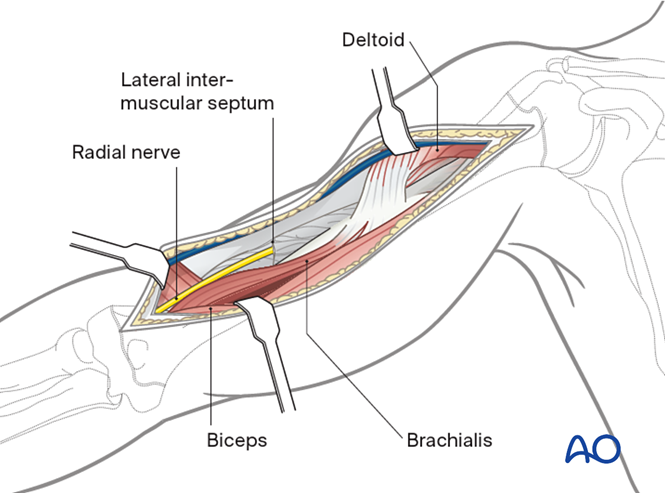
Surgical Approach
Nailing uses a small shoulder entry point. Shaft plating uses an anterolateral approach, while proximal fractures use deltopectoral or deltoid-splitting access.
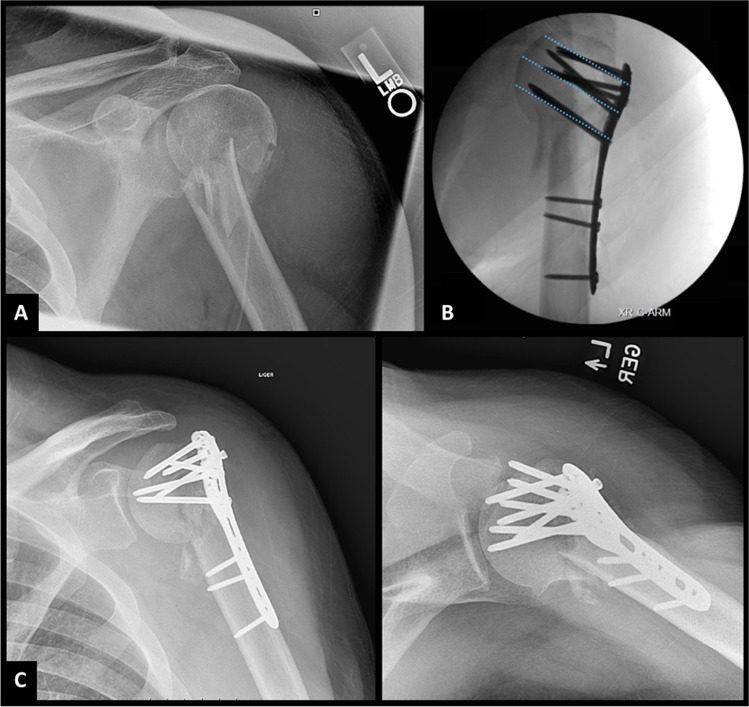
Fracture Reduction
Fragments are aligned and held temporarily. In proximal fractures, the tuberosities are reduced with their rotator cuff attachments before definitive fixation.
Definitive Fixation
A locked nail or plate secures the fracture. Proximal locking screws and tuberosity sutures stabilise complex shoulder patterns under fluoroscopic guidance.
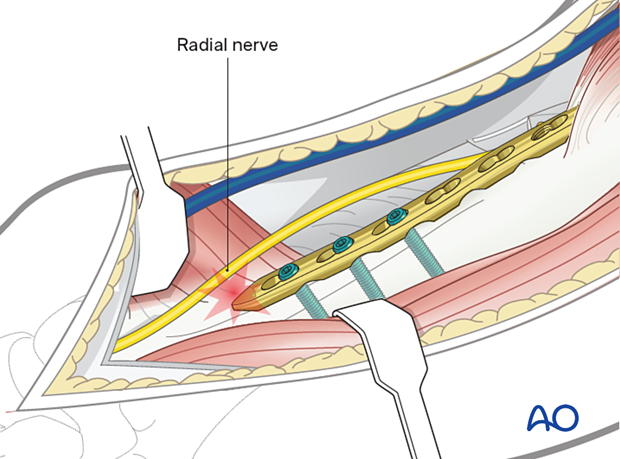
Radial Nerve Assessment
The radial nerve is confirmed free from the implant. If palsy existed before surgery, the nerve is explored and checked for continuity.
Closure and Immobilisation
The wound is closed in layers and protected with a sling or functional brace. Physiotherapy guidance is provided before discharge.
Arm Fracture Fixation Recovery Timeline in Dubai
Recovery protects the repair while progressively restoring shoulder motion, elbow movement and arm strength.
Weeks 0 to 2
Sling Protection
Protect the fixation while beginning safe movement of the elbow, wrist and hand.
- Support
- Sling or functional brace remains in place
- Movement
- Elbow and wrist motion begins immediately
- Shoulder
- Pendulum exercises usually begin within 1 to 2 weeks
Weeks 2 to 6
Early Active Motion
Supervised shoulder movement progresses gradually as sling use is reduced.
- Shoulder
- Active-assisted flexion and abduction within comfort
- Elbow
- Full flexion and extension are encouraged
- Goal
- Progress towards 90 degrees of shoulder flexion
Weeks 6 to 12
Progressive Strengthening
Resistance is introduced after imaging confirms satisfactory fracture healing.
- Strength
- Progressive resistance for the shoulder and elbow
- Imaging
- X-ray at 6 to 8 weeks checks callus formation
- Nerve
- Radial nerve recovery is monitored when required
Months 3 to 6
Return to Full Activity
Full activities resume after union, motion and functional strength are confirmed.
- Shaft fixation
- Full activity often returns at 3 to 4 months
- Proximal fixation
- Rehabilitation commonly continues for 4 to 6 months
- Arthroplasty
- Functional recovery may continue for 6 to 12 months
Patient Outcomes: Arm Fracture Fixation in Dubai
Three patients describe recovery after humeral shaft fixation, proximal humerus plating and reverse shoulder arthroplasty.
I fractured my humeral shaft in a car accident and developed wrist drop. Dr. Ali plated the fracture and explored the radial nerve. My wrist recovered by 3 months, and I returned to work at 4 months.
Dr. Ali performed locking plate fixation after my fall. I began pendulum exercises at 10 days, and by 5 months I had functional shoulder elevation and had returned to normal daily activities.
At age 68, Dr. Ali recommended reverse shoulder arthroplasty for my complex fracture. At 9 months I could lift my arm above my head and sleep comfortably again.
Patient experiences are individual. Recovery varies with fracture complexity, nerve involvement, healing and participation in rehabilitation.
Risks and Outcomes of Arm Fracture Fixation in Dubai
Dr. Mohamed Ali explains procedure-specific risks, prevention strategies and realistic recovery expectations before surgery.
Radial Nerve Injury
Radial nerve palsy may accompany a humeral shaft fracture. Most primary palsies recover, while a new palsy after manipulation requires urgent surgical assessment.
The nerve is identified and protected throughout the anterolateral approach.
Non-union
Humeral shaft non-union occurs in approximately 5 to 10 percent of surgically treated cases. Risk increases with open injury, comminution, smoking and premature loading.
Serial X-rays track healing; established non-union may require grafting and revision fixation.
Avascular Necrosis
Four-part proximal humerus fractures can disrupt blood supply to the humeral head, causing progressive collapse, pain and loss of function.
Soft-tissue attachments are preserved and circumferential dissection is avoided.
Shoulder Stiffness
Restricted elevation affects approximately 20 to 40 percent of patients after proximal humerus fixation. Risk is influenced by fracture severity and rehabilitation timing.
Early supervised physiotherapy restores motion while protecting the healing construct.
Why Choose Dr. Mohamed Ali for Arm Fracture Fixation in Dubai
Successful treatment depends on accurate fracture classification, appropriate implant selection and meticulous radial nerve protection.
Fellowship-Trained Upper Limb Trauma Surgeon
Dr. Ali's training covers humeral shaft fractures with radial nerve palsy and complex proximal humerus fractures requiring fixation or reverse arthroplasty.
CT-Based Neer Classification
Proximal humerus fractures are assessed on CT before choosing between plate fixation and arthroplasty, revealing displacement and comminution that X-rays may underestimate.
Radial Nerve Protocol
Radial nerve function is documented before and after treatment. Direct nerve identification and protection are standard during anterolateral humeral shaft fixation.
DHA Licensed Facilities
Surgery is performed at DHA-regulated facilities with humeral nails, proximal locking plates, reverse shoulder implants and intraoperative fluoroscopy.
No Referral Required
Book directly without a GP or specialist referral. For an acute arm fracture, call +971 50 254 4263. Consultations are available every day from 9 AM to 5 PM in Dubai.
Arm Fracture in Dubai? Book a Specialist Assessment Today.
Dr. Mohamed Ali will classify the fracture, assess radial nerve function and advise whether bracing, fixation or arthroplasty is most appropriate. No referral required.
Related Surgical Procedures in Dubai
Forearm Fracture Fixation Dubai
Both-bone, Galeazzi and Monteggia forearm fracture plating at DHA-licensed facilities in Dubai.
Elbow Fracture Fixation Dubai
Radial head, olecranon and distal humerus fracture fixation in Dubai.
Revision Surgery Dubai
Complex revision of failed upper limb fracture fixation and non-union surgery in Dubai.
Arm Fracture Fixation Available in Dubai, UAE
Dr. Mohamed Ali performs arm fracture fixation at DHA-licensed facilities in Dubai. Patients from across the UAE travel for specialist humeral shaft and proximal humerus fracture surgery, with direct booking available without a referral.
Dubai
DHA-licensed facilities providing humeral shaft fixation, proximal humerus reconstruction and reverse shoulder arthroplasty.
Direct booking · No referral requiredAbu Dhabi
Patients travel to Dubai for independent fracture review, surgical fixation and coordinated rehabilitation.
Humeral shaft · Proximal humerusSharjah
Direct access to upper limb trauma assessment for displaced and complex arm fracture patterns.
Assessment · Fixation · Follow-upNorthern Emirates
Specialist surgical care for humeral fractures, radial nerve injury and complex shoulder reconstruction in Dubai.
Nailing · Plating · ArthroplastyEverything you need to contact or visit the Dubai practice.
Searching for arm fracture fixation near me or an arm fracture specialist near me in the UAE? For acute fractures, call +971 50 254 4263 immediately.
Book a Direct ConsultationFrequently Asked Questions
Arm Fracture Fixation in Dubai
How long does it take to recover from a broken arm?
Recovery depends on the fracture type. Humeral shaft intramedullary nailing: return to full activities at 3 to 4 months. Proximal humerus plate fixation: structured physiotherapy for 4 to 6 months. Reverse shoulder arthroplasty: 6 to 12 months for full functional recovery. Dr. Mohamed Ali provides a personalised recovery timeline at your Dubai consultation.
Does a broken humerus always need surgery?
Not always. Humeral shaft fractures with acceptable alignment can be managed with a functional brace. Displaced fractures, open fractures and fractures with radial nerve or vascular injury require surgery. Proximal humerus fractures are assessed using the Neer classification. Dr. Mohamed Ali advises on surgical versus non-operative management at his DHA-licensed Dubai practice.
What is the best treatment for a proximal humerus fracture?
Treatment depends on the Neer classification and patient activity level. Minimally displaced 2-part fractures are managed non-operatively. Displaced 2-part and most 3-part fractures in active patients are treated with proximal humerus locking plate fixation. 4-part fractures with high avascular necrosis risk in older patients are treated with reverse shoulder arthroplasty. Dr. Mohamed Ali assesses each fracture individually at his Dubai practice.
Can you move your arm with a broken humerus?
Limited movement may be possible, but pain and swelling typically make it difficult. More importantly, check for wrist drop. Inability to extend the wrist or fingers after an arm injury indicates radial nerve involvement requiring urgent specialist assessment. Call +971 50 254 4263 for an urgent assessment in Dubai.
How serious is a humeral shaft fracture?
A humeral shaft fracture is a significant injury. Radial nerve palsy occurs in 10 to 18 percent of cases. Most primary palsies recover spontaneously but must be monitored. Vascular injury, though rare, is an emergency. Most humeral shaft fractures can be braced if alignment is acceptable. Displaced, open or nerve-associated fractures require surgical management at Dr. Ali’s DHA-licensed Dubai practice.
Do I need a referral for arm fracture surgery in Dubai?
No referral is required. You can book an arm fracture consultation with Dr. Mohamed Ali directly without a GP or specialist referral. For acute arm fractures, call +971 50 254 4263 urgently. Consultations are available everyday from 9 AM to 5 PM in Dubai. If you are searching for arm fracture fixation near me in the UAE, book directly online today.
Book Your Arm Fracture Fixation Consultation in Dubai
Dr. Mohamed Ali performs arm fracture fixation in Dubai, UAE. Fellowship-trained. DHA licensed. Humeral shaft nailing and plating, proximal humerus locking plate fixation, reverse shoulder arthroplasty, periprosthetic fracture management.
+971 50 254 4263
Everyday: 9 AM – 5 PM
m.ali@dubaihand.com
Dubai, UAE
Thank you — your message was sent.
