
Patient Connection Hub Skip to main content

Dr. Mohammad Ali

Coming Soon

Stem Cell Injection Dubai

Arm Fracture Fixation Surgery in Dubai by Dr. Mohamed Ali

Fellowship-Trained Wrist Surgeon  |  DHA Licensed  |  Arthroscopic Ligament Repair  |  Upper Limb Specialist  |  Dubai, UAE

Dr. Mohamed Ali is a fellowship-trained hand and wrist surgeon in Dubai performing arm fracture fixation for humeral shaft fractures, proximal humerus fractures, surgical neck fractures and periprosthetic fractures around shoulder implants. Each fracture is assessed individually: the decision between functional bracing, intramedullary nailing, plate fixation and reverse shoulder arthroplasty depends on the fracture pattern, the patient's age and activity level and the presence of associated radial nerve or vascular injury. Arm fracture fixation near me in Dubai is available. No referral required.

Understanding humerus fracture repair

What Is Arm Fracture Fixation?

The humerus is the single bone connecting the shoulder to the elbow. Arm fractures affect either its shaft or the proximal region beside the shoulder.

Every arm fracture fixation Dubai assessment includes full-length X-rays, radial nerve testing and CT imaging for proximal or complex fracture patterns.

Stable shaft fractures may heal in a functional brace. Displaced, open or nerve-associated injuries may need plating or nailing, while Neer classification guides fixation or arthroplasty for proximal fractures.

Two Key RegionsShaft and proximal humerus fractures require different treatment strategies
Radial Nerve CheckWrist and thumb extension are documented before every treatment decision
CT-Based PlanningComplex proximal fractures are classified before fixation or arthroplasty
Orthopaedic specialist reviewing shoulder and humerus radiographs Specialist fracture assessment
Classify before treatmentImaging and nerve examination define the safest fixation strategy
Fracture patterns treated

Types of Arm Fractures Treated in Dubai

Arm fracture fixation Dubai is planned around the fracture level, CT findings, radial nerve function and the patient's activity needs.

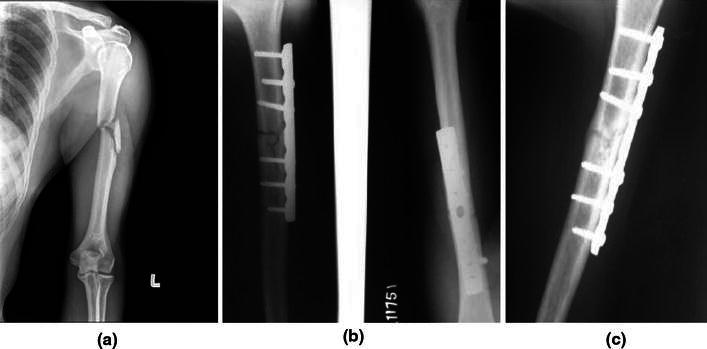
Two-view X-ray showing a displaced humeral shaft fracture
Mid-arm injury

Humeral Shaft Fracture

Mid-shaft fractures may heal in a functional brace when alignment is acceptable. Displaced, open or nerve-associated injuries are stabilised with a plate or intramedullary nail.

Shoulder X-ray showing a displaced two-part proximal humerus fracture
Surgical neck or tuberosity

Proximal Humerus Fracture, 2-Part

Displaced surgical-neck fractures in active patients may need locking-plate fixation. Greater tuberosity displacement above 5mm is treated to prevent impingement.

Shoulder radiographs showing a complex four-part proximal humerus fracture
Complex shoulder fracture

Proximal Humerus Fracture, 3-Part and 4-Part

CT defines tuberosity and head fragmentation. Locking-plate fixation suits selected active patients, while reverse shoulder arthroplasty may be safer for complex older-patient patterns.

X-rays showing a periprosthetic humerus fracture before and after fixation
Fracture around an implant

Periprosthetic Humerus Fracture

CT confirms whether the shoulder or elbow implant remains stable. A fixed implant may be plated around, while a loose component requires revision and fracture fixation.

Orthopaedic surgical team performing complex upper arm fracture fixation
Urgent trauma care

Open Arm Fractures

A wound communicating with the fracture needs urgent antibiotics, debridement and radial nerve protection. Stable fixation follows according to contamination and soft-tissue damage.

Why accurate fixation matters

Complications if Arm Fractures Are Left Untreated or Inadequately Managed

Delayed diagnosis or poor alignment can compromise radial nerve function, bone healing and long-term shoulder movement.

Humeral shaft fracture with illustration of the radial nerve at risk Spiral groove risk
Complication 01

Radial Nerve Palsy

The radial nerve crosses the humeral shaft and may be injured at fracture or during manipulation. Persistent damage can cause wrist drop and loss of thumb extension.

Key consequencePersistent wrist and finger extension weakness

Specialist arm fracture fixation Dubai assessment protects nerve function, shoulder alignment and reliable bone healing.

A complete injury assessment

Diagnosing Arm Fractures in Dubai

Diagnosis defines the humerus fracture pattern, checks radial nerve and circulation, and confirms whether fixation or non-operative care is safest.

01

Clinical Examination

The injury mechanism, swelling, bruising and deformity help define the fracture level and reveal open wounds or soft-tissue damage.

02

Radial Nerve Function

Wrist extension, thumb extension and dorsal-hand sensation are documented before and after every fracture intervention.

03

Vascular Status

Radial and brachial pulses are checked immediately. A pale or pulseless hand requires urgent vascular surgical assessment.

04

X-rays and CT Planning

Two-plane X-rays assess every suspected fracture. CT is essential for proximal, periprosthetic and complex multi-fragment patterns.

Specialist review before fixation Dr. Mohamed Ali reviews the imaging and radial nerve findings before finalising every arm fracture fixation Dubai plan. Direct booking is available without a referral.

Fixation matched to the fracture

Surgical Fixation Techniques for Arm Fractures in Dubai

The technique is selected from the fracture level, CT findings, radial nerve status, bone quality and the patient's functional needs.
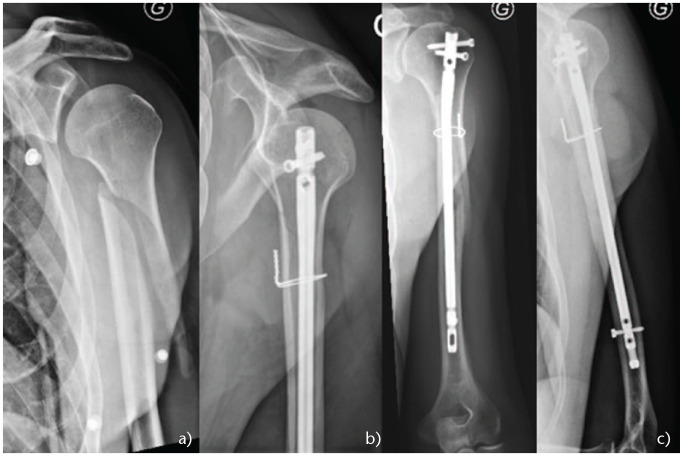
Radiographic sequence showing intramedullary nail fixation of a humeral shaft fracture
Load-sharing humeral fixation
01

Intramedullary Nailing

A locked nail spans the humeral canal to control length and rotation. This load-sharing construct supports early shoulder and elbow movement while limiting soft-tissue disruption.

Humerus X-rays showing plate fixation of a shaft fracture
Direct shaft reduction and plating
02

Plate Fixation

A broad compression or locking plate restores humeral-shaft alignment. Plating is especially useful when radial nerve exploration, bone grafting or distal-shaft control is required.

Postoperative shoulder X-rays showing proximal humerus locking plate fixation
Angular stability in the humeral head
03

Proximal Humerus Locking Plate

A pre-contoured plate and multiple locking screws stabilise the head and tuberosities. The approach preserves soft-tissue attachments and supports early pendulum exercises.

Postoperative radiographs showing reverse shoulder arthroplasty for proximal humerus fractures
Replacement for complex fracture patterns
04

Reverse Shoulder Arthroplasty

Selected complex 4-part fractures and failed fixation may be treated with reverse arthroplasty. The implant allows deltoid-powered elevation when reliable reconstruction is unlikely.

Your pre-operative pathway

Preparing for Arm Fracture Fixation in Dubai

Imaging, radial nerve function, circulation, anaesthetic fitness and early rehabilitation are confirmed before surgery.

01
Define the fracture pattern

Imaging Review

Full-length humerus X-rays are reviewed. CT defines proximal, periprosthetic and complex fractures and supports Neer classification.

X-ray and CT
02
Protect nerve and circulation

Nerve and Vascular Assessment

Radial nerve function and brachial pulse are documented. New wrist drop after manipulation requires urgent surgical exploration.

Before surgery
03
Confirm anaesthetic fitness

Medical Clearance

Fitness for general or regional anaesthesia is confirmed. Older patients may require additional cardiac or medical review.

Pre-operative review
04
Plan medication safely

Medication Review

Blood-thinning medication may need adjustment 5 to 7 days before elective surgery. Urgent cases are coordinated with the anaesthetic team.

5 to 7 days
05
Follow anaesthetic instructions

Fasting

Avoid food for 6 hours and clear fluids for 2 hours before general anaesthesia. Exact arrival instructions are provided in advance.

6 hours and 2 hours
06
Prepare for early recovery

Post-Operative Planning

Arrange a driver. A sling or arm brace is fitted after surgery, and supervised shoulder and elbow therapy usually begins within 1 to 2 weeks.

Plan before admission
YOUR OPERATION, STEP BY STEP

Arm Fracture Fixation: Step by Step

Each stage restores humeral alignment while protecting the radial nerve, shoulder and elbow.

Specialist surgical team preparing for proximal humerus fracture fixation
Comfort and positioning

Anaesthesia

General anaesthesia is combined with a regional block. Positioning is selected for the fracture level, and fluoroscopy is prepared before fixation begins.
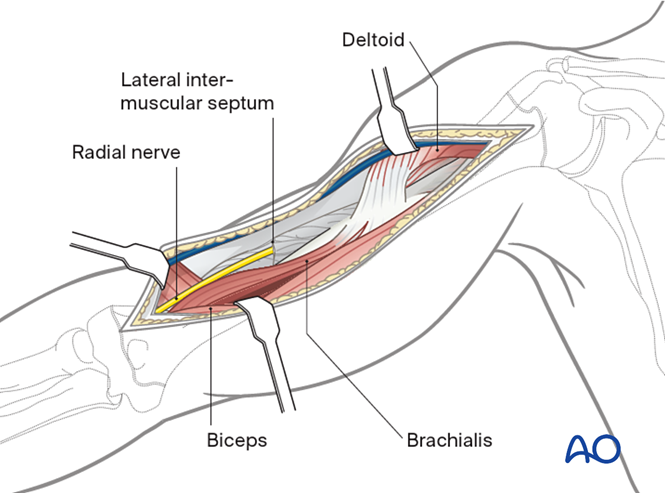
Medical illustration of the anterolateral approach to the humeral shaft
Access matched to the fracture

Surgical Approach

Nailing uses a small shoulder entry point. Shaft plating uses an anterolateral approach, while proximal fractures use deltopectoral or deltoid-splitting access.
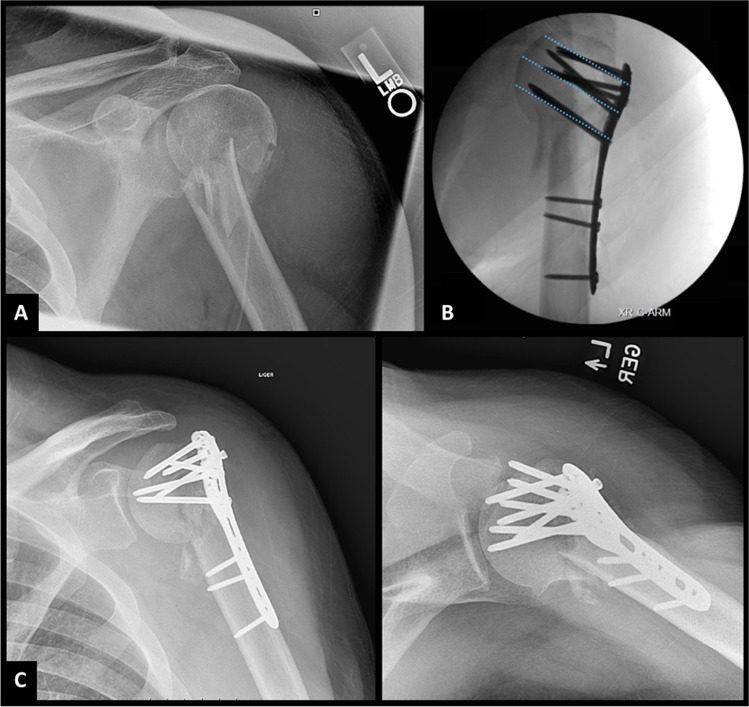
Fluoroscopic images showing reduction of a proximal humerus fracture
Restore anatomy

Fracture Reduction

Fragments are aligned and held temporarily. In proximal fractures, the tuberosities are reduced with their rotator cuff attachments before definitive fixation.

Fluoroscopic images of humeral intramedullary nail fixation
Stable implant placement

Definitive Fixation

A locked nail or plate secures the fracture. Proximal locking screws and tuberosity sutures stabilise complex shoulder patterns under fluoroscopic guidance.
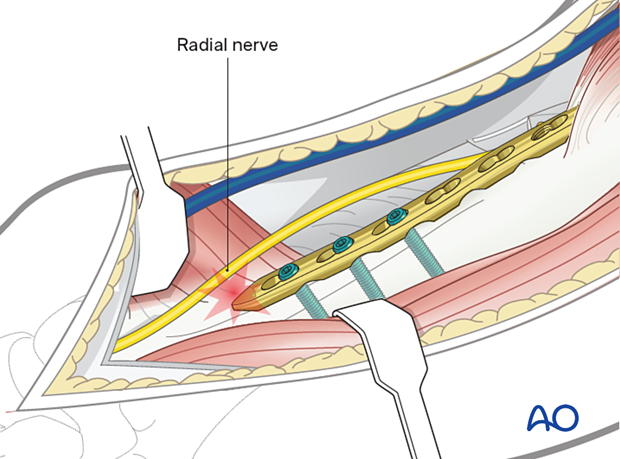
Medical illustration showing the radial nerve beside humeral plate fixation
Protect neurological function

Radial Nerve Assessment

The radial nerve is confirmed free from the implant. If palsy existed before surgery, the nerve is explored and checked for continuity.

Patient wearing an arm sling for humerus fracture protection
Protection before discharge

Closure and Immobilisation

The wound is closed in layers and protected with a sling or functional brace. Physiotherapy guidance is provided before discharge.

A STRUCTURED RETURN TO FUNCTION

Arm Fracture Fixation Recovery Timeline in Dubai

Recovery protects the repair while progressively restoring shoulder motion, elbow movement and arm strength.

01Protect
02Mobilise
03Strengthen
04Return
Patient wearing a shoulder sling while a clinician reviews a proximal humerus X-ray Weeks 0 to 2
01

Sling Protection

Protect the fixation while beginning safe movement of the elbow, wrist and hand.

Support
Sling or functional brace remains in place
Movement
Elbow and wrist motion begins immediately
Shoulder
Pendulum exercises usually begin within 1 to 2 weeks
Wound and fixation review is arranged at approximately 2 weeks
Physiotherapist guiding a patient's shoulder through supported movement Weeks 2 to 6
02

Early Active Motion

Supervised shoulder movement progresses gradually as sling use is reduced.

Shoulder
Active-assisted flexion and abduction within comfort
Elbow
Full flexion and extension are encouraged
Goal
Progress towards 90 degrees of shoulder flexion
Movement increases without overloading the healing construct
Physiotherapist supervising resistance-band shoulder strengthening Weeks 6 to 12
03

Progressive Strengthening

Resistance is introduced after imaging confirms satisfactory fracture healing.

Strength
Progressive resistance for the shoulder and elbow
Imaging
X-ray at 6 to 8 weeks checks callus formation
Nerve
Radial nerve recovery is monitored when required
Light manual activities resume only after clinical review
Follow-up X-rays showing humeral shaft union after plate fixation Months 3 to 6
04

Return to Full Activity

Full activities resume after union, motion and functional strength are confirmed.

Shaft fixation
Full activity often returns at 3 to 4 months
Proximal fixation
Rehabilitation commonly continues for 4 to 6 months
Arthroplasty
Functional recovery may continue for 6 to 12 months
Final clearance depends on union, motion, strength and symptoms
Patient experiences

Patient Outcomes: Arm Fracture Fixation in Dubai

Three patients describe recovery after humeral shaft fixation, proximal humerus plating and reverse shoulder arthroplasty.

Humeral shaft fracture

I fractured my humeral shaft in a car accident and developed wrist drop. Dr. Ali plated the fracture and explored the radial nerve. My wrist recovered by 3 months, and I returned to work at 4 months.

3 monthsRadial nerve function recovered
4 monthsReturned to work
Omar S.Dubai, UAE
Four-part proximal humerus fracture

At age 68, Dr. Ali recommended reverse shoulder arthroplasty for my complex fracture. At 9 months I could lift my arm above my head and sleep comfortably again.

Age 68Arthroplasty selected for the fracture pattern
9 monthsComfortable overhead movement
Peter K.Abu Dhabi, UAE

Patient experiences are individual. Recovery varies with fracture complexity, nerve involvement, healing and participation in rehabilitation.

Transparent surgical guidance

Risks and Outcomes of Arm Fracture Fixation in Dubai

Dr. Mohamed Ali explains procedure-specific risks, prevention strategies and realistic recovery expectations before surgery.

01 Neurological protection

Radial Nerve Injury

Radial nerve palsy may accompany a humeral shaft fracture. Most primary palsies recover, while a new palsy after manipulation requires urgent surgical assessment.

Surgical safeguard

The nerve is identified and protected throughout the anterolateral approach.

02 Bone healing

Non-union

Humeral shaft non-union occurs in approximately 5 to 10 percent of surgically treated cases. Risk increases with open injury, comminution, smoking and premature loading.

Management

Serial X-rays track healing; established non-union may require grafting and revision fixation.

03 Humeral head viability

Avascular Necrosis

Four-part proximal humerus fractures can disrupt blood supply to the humeral head, causing progressive collapse, pain and loss of function.

Risk reduction

Soft-tissue attachments are preserved and circumferential dissection is avoided.

04 Functional recovery

Shoulder Stiffness

Restricted elevation affects approximately 20 to 40 percent of patients after proximal humerus fixation. Risk is influenced by fracture severity and rehabilitation timing.

Prevention

Early supervised physiotherapy restores motion while protecting the healing construct.

Specialist upper limb trauma care

Why Choose Dr. Mohamed Ali for Arm Fracture Fixation in Dubai

Successful treatment depends on accurate fracture classification, appropriate implant selection and meticulous radial nerve protection.

01

Fellowship-Trained Upper Limb Trauma Surgeon

Dr. Ali's training covers humeral shaft fractures with radial nerve palsy and complex proximal humerus fractures requiring fixation or reverse arthroplasty.

02

CT-Based Neer Classification

Proximal humerus fractures are assessed on CT before choosing between plate fixation and arthroplasty, revealing displacement and comminution that X-rays may underestimate.

03

Radial Nerve Protocol

Radial nerve function is documented before and after treatment. Direct nerve identification and protection are standard during anterolateral humeral shaft fixation.

04

DHA Licensed Facilities

Surgery is performed at DHA-regulated facilities with humeral nails, proximal locking plates, reverse shoulder implants and intraoperative fluoroscopy.

05

No Referral Required

Book directly without a GP or specialist referral. For an acute arm fracture, call +971 50 254 4263. Consultations are available every day from 9 AM to 5 PM in Dubai.

⋮⋮⋮⋮
Specialist arm fracture assessment

Arm Fracture in Dubai? Book a Specialist Assessment Today.

Dr. Mohamed Ali will classify the fracture, assess radial nerve function and advise whether bracing, fixation or arthroplasty is most appropriate. No referral required.

Book a Fracture Assessment No referral required
DHA Licensed Arm Fracture Fixation Specialist Fellowship-Trained Upper Limb Surgeon Dubai, UAE
Specialist care across the UAE

Arm Fracture Fixation Available in Dubai, UAE

Dr. Mohamed Ali performs arm fracture fixation at DHA-licensed facilities in Dubai. Patients from across the UAE travel for specialist humeral shaft and proximal humerus fracture surgery, with direct booking available without a referral.

01
Primary specialist location

Dubai

DHA-licensed facilities providing humeral shaft fixation, proximal humerus reconstruction and reverse shoulder arthroplasty.

Direct booking · No referral required
02
Patients welcomed from

Abu Dhabi

Patients travel to Dubai for independent fracture review, surgical fixation and coordinated rehabilitation.

Humeral shaft · Proximal humerus
03
Patients welcomed from

Sharjah

Direct access to upper limb trauma assessment for displaced and complex arm fracture patterns.

Assessment · Fixation · Follow-up
04
Patients welcomed from

Northern Emirates

Specialist surgical care for humeral fractures, radial nerve injury and complex shoulder reconstruction in Dubai.

Nailing · Plating · Arthroplasty
Practice details

Everything you need to contact or visit the Dubai practice.

Specialist Dr. Mohamed Ali
Address BONEX KLINIK, Dubai, UAE Open in Google Maps Telephone +971 50 254 4263 Tap to call Email m.ali@dubaihand.com Tap to email
Opening hours Everyday, 9 AM to 5 PM

Searching for arm fracture fixation near me or an arm fracture specialist near me in the UAE? For acute fractures, call +971 50 254 4263 immediately.

Book a Direct Consultation
Frequently Asked Questions
Arm Fracture Fixation in Dubai
How long does it take to recover from a broken arm?

Recovery depends on the fracture type. Humeral shaft intramedullary nailing: return to full activities at 3 to 4 months. Proximal humerus plate fixation: structured physiotherapy for 4 to 6 months. Reverse shoulder arthroplasty: 6 to 12 months for full functional recovery. Dr. Mohamed Ali provides a personalised recovery timeline at your Dubai consultation.

Not always. Humeral shaft fractures with acceptable alignment can be managed with a functional brace. Displaced fractures, open fractures and fractures with radial nerve or vascular injury require surgery. Proximal humerus fractures are assessed using the Neer classification. Dr. Mohamed Ali advises on surgical versus non-operative management at his DHA-licensed Dubai practice.

Treatment depends on the Neer classification and patient activity level. Minimally displaced 2-part fractures are managed non-operatively. Displaced 2-part and most 3-part fractures in active patients are treated with proximal humerus locking plate fixation. 4-part fractures with high avascular necrosis risk in older patients are treated with reverse shoulder arthroplasty. Dr. Mohamed Ali assesses each fracture individually at his Dubai practice.

Limited movement may be possible, but pain and swelling typically make it difficult. More importantly, check for wrist drop. Inability to extend the wrist or fingers after an arm injury indicates radial nerve involvement requiring urgent specialist assessment. Call +971 50 254 4263 for an urgent assessment in Dubai.

A humeral shaft fracture is a significant injury. Radial nerve palsy occurs in 10 to 18 percent of cases. Most primary palsies recover spontaneously but must be monitored. Vascular injury, though rare, is an emergency. Most humeral shaft fractures can be braced if alignment is acceptable. Displaced, open or nerve-associated fractures require surgical management at Dr. Ali’s DHA-licensed Dubai practice.

No referral is required. You can book an arm fracture consultation with Dr. Mohamed Ali directly without a GP or specialist referral. For acute arm fractures, call +971 50 254 4263 urgently. Consultations are available everyday from 9 AM to 5 PM in Dubai. If you are searching for arm fracture fixation near me in the UAE, book directly online today.

Book Your Arm Fracture Fixation Consultation in Dubai

Dr. Mohamed Ali performs arm fracture fixation in Dubai, UAE. Fellowship-trained. DHA licensed. Humeral shaft nailing and plating, proximal humerus locking plate fixation, reverse shoulder arthroplasty, periprosthetic fracture management.

+971 50 254 4263

Everyday: 9 AM – 5 PM

m.ali@dubaihand.com

Dubai, UAE

Main Contact Form