
Stem Cell Injection Dubai
Forearm Fracture Fixation Surgery in Dubai by Dr. Mohamed Ali
Fellowship-Trained Wrist Surgeon | DHA Licensed | Arthroscopic Ligament Repair | Upper Limb Specialist | Dubai, UAE
Dr. Mohamed Ali is a fellowship-trained hand and wrist surgeon in Dubai performing forearm fracture fixation for both-bone forearm fractures, isolated radius and ulna fractures, Galeazzi fracture-dislocations and Monteggia injuries. The radius and ulna work as a pair: accurate plating of both bones restores forearm rotation and prevents the malunion that causes permanent loss of pronation and supination. If you have a forearm fracture near me in Dubai requiring surgical assessment, Dr. Ali provides specialist care without a referral. Forearm fracture fixation Dubai covers all forearm fracture patterns from simple isolated shaft fractures to complex Galeazzi and Monteggia injuries, with intraoperative DRUJ and radiocapitellar assessment as a standard step at every procedure.
What Is Forearm Fracture Fixation?
The radius and ulna work as one rotating unit. A fracture can disrupt their length, alignment, rotation and load-sharing function across the entire forearm.
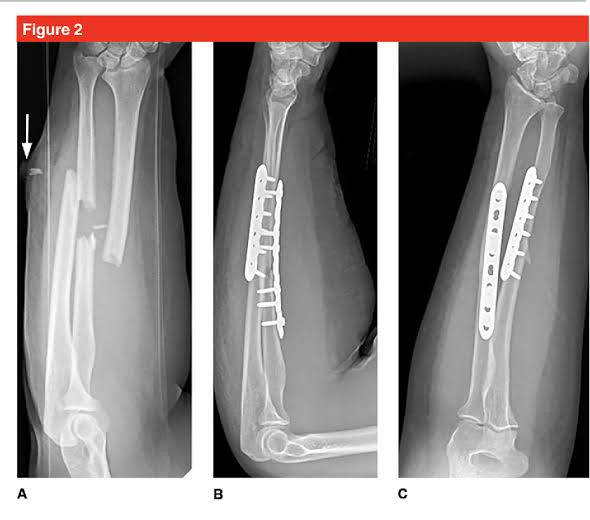
Every forearm fracture fixation Dubai assessment includes full-length X-rays of the wrist and elbow. CT is added for comminuted fractures or suspected joint involvement.
Forearm fracture fixation Dubai uses plates and screws to restore anatomical alignment and stable rotation. In adults, displaced shaft fractures rarely remain accurately positioned in a cast, making early fixation standard for most patterns.
Pre-operative imaging
Types of Forearm Fractures Treated in Dubai
Forearm fracture fixation Dubai is planned around the exact bone pattern and any associated instability at the wrist or elbow.
01
Both-Bone Forearm Fracture
Both the radius and ulna are fractured at shaft level. Each bone is restored independently with its own plate and screws, rebuilding length, alignment and the forearm's pronation and supination mechanics.
02
Galeazzi Fracture
A radial shaft fracture combined with distal radioulnar joint dislocation. The radius is plated first, then DRUJ stability is tested under fluoroscopy and temporarily stabilised when required.
03
Monteggia Fracture
The proximal ulna fractures while the radial head dislocates at the elbow. Restoring ulna length and alignment usually reduces the radial head; persistent dislocation requires direct exploration.
04
Isolated Radius or Ulna Fracture
Displaced radial shaft fractures usually require plating to preserve rotation. A stable nightstick ulna fracture may be treated without surgery when displacement and angulation remain within safe limits.
05
Open Forearm Fractures
A wound communicates with the fracture, requiring urgent antibiotics, surgical debridement and stable fixation. Contamination, bone loss and soft tissue damage determine the final reconstruction plan.
Complications if Forearm Fractures Are Left Untreated or Inadequately Fixed
Delayed treatment or inaccurate forearm fracture fixation can permanently affect rotation, wrist stability and bone healing.
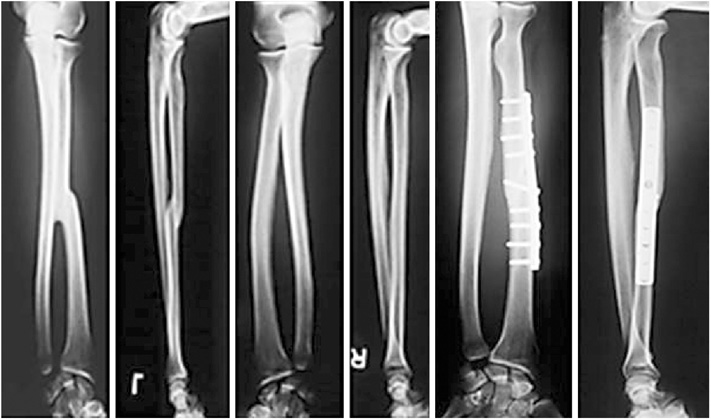
Rotation mechanics
Malunion and Permanent Rotation Loss
Angled healing changes the radius arc around the ulna and restricts pronation and supination. Even modest deformity can cause lasting motion loss, often requiring a more complex corrective osteotomy.
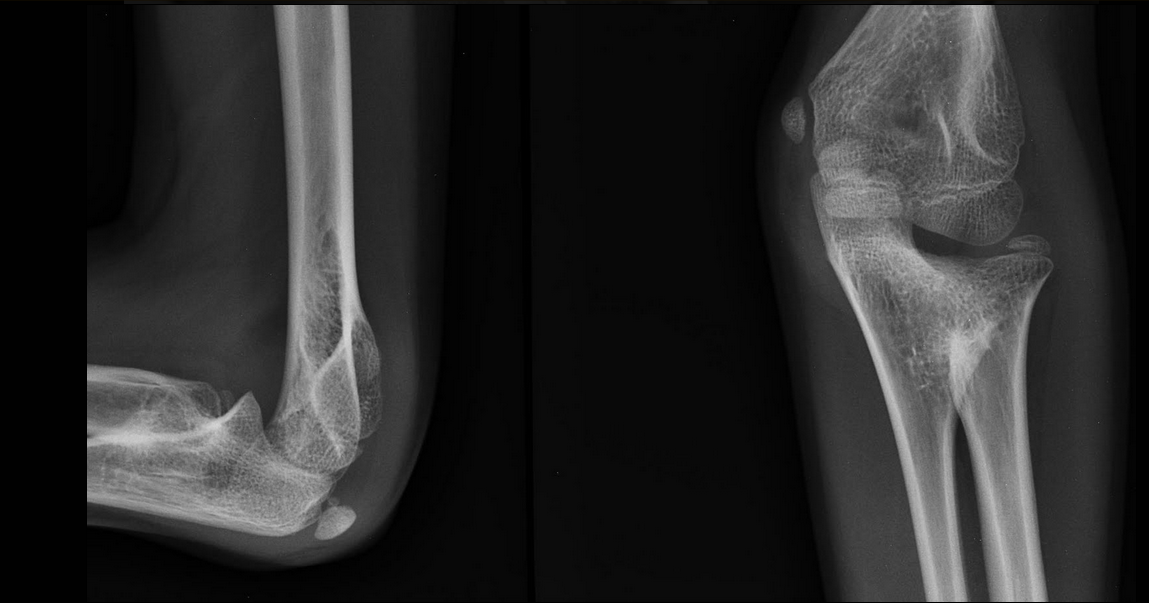
Bone bridge formation
Radio-ulnar Synostosis
A pathological bone bridge forms between the radius and ulna, blocking rotation completely. High-energy injury, delayed surgery and single-incision plating increase the risk. Established synostosis requires surgical excision.
Missed DRUJ Injury
An untreated distal radioulnar joint injury causes chronic wrist pain, clicking, weakness and unstable rotation. Primary assessment during radius fixation is more reliable than late DRUJ reconstruction.
Failure of bone healing
Non-union
The fracture fails to heal, producing pain, deformity and eventual implant failure. Open injury, bone loss, smoking and premature loading increase risk. Revision usually requires bone grafting and new plate fixation.
Specialist forearm fracture fixation Dubai assessment identifies these risks early and protects wrist, elbow and rotational function.
Diagnosing Forearm Fractures in Dubai
Diagnosis confirms the fracture pattern, protects nerves and circulation, and identifies associated wrist or elbow instability before treatment is planned.
Clinical Examination
The injury mechanism, swelling, tenderness and deformity help define the fracture pattern and identify open wounds or associated soft tissue damage.
Neurovascular Assessment
Radial and ulnar pulses are checked with sensation and motor function across the median, ulnar and radial nerve distributions.
Compartment Syndrome Screening
Severe disproportionate pain, a tense forearm and pain with passive finger extension require urgent pressure assessment and immediate surgical action.
X-rays and CT Planning
Full-length X-rays include the wrist and elbow to exclude Galeazzi or Monteggia injuries. CT supports comminuted, late or corrective osteotomy planning.
Specialist review before fixation Dr. Mohamed Ali reviews the complete imaging set before finalising every forearm fracture fixation Dubai operative plan. Direct booking is available without a referral.
Surgical Fixation Techniques for Forearm Fractures in Dubai
Dr. Mohamed Ali uses separate approaches and independent fixation constructs to restore alignment, protect forearm rotation and reduce the risk of radio-ulnar synostosis.
Dual-Plate ORIF
The radius is fixed through a volar Henry approach and the ulna through a separate subcutaneous approach. Independent 3.5 mm plates restore length, alignment and rotational stability while protecting the interosseous space. Union rates commonly reach 95 to 98 percent.
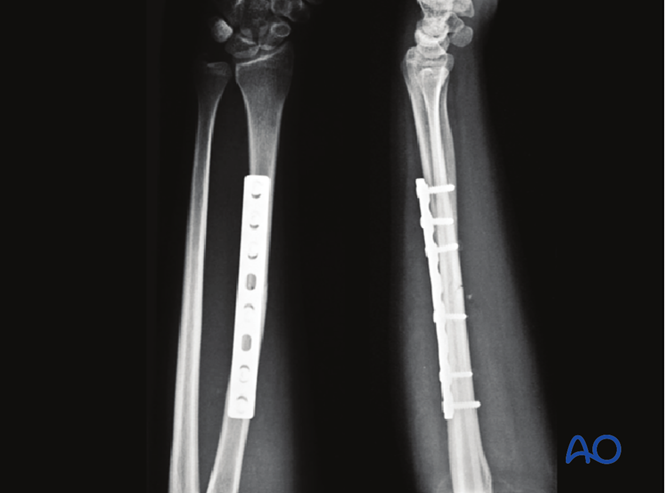
Galeazzi Fracture Repair
After radius plating, the distal radioulnar joint is tested clinically and under fluoroscopy in full supination. A stable joint is protected in a splint. Persistent instability is secured temporarily with a K-wire for 4 to 6 weeks.
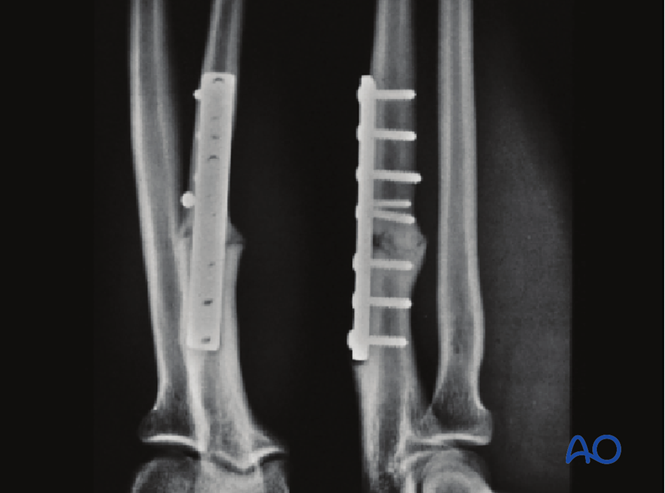
Monteggia Fracture Repair
The ulna is plated first to restore its exact length, alignment and rotation. The radial head should then reduce naturally. If it remains displaced, the radiocapitellar joint is explored and any obstructing tissue is addressed directly.
Intramedullary Nailing
Flexible nails can be inserted through small incisions in selected paediatric, adolescent or soft-tissue-sensitive cases. Because nails offer less rotational control than plates, their use in adult forearm fracture fixation is carefully selected.
Preparing for Forearm Fracture Fixation in Dubai
Imaging, circulation, nerve function, anaesthetic fitness and the recovery plan are confirmed before surgery so treatment can proceed safely and efficiently.
Imaging Review
Full-length forearm X-rays include the wrist and elbow to identify Galeazzi or Monteggia patterns. CT is added for comminuted fractures and late-presenting injuries.
X-ray and CTNeurovascular Assessment
Radial and ulnar pulses, median, radial and ulnar nerve function, skin wounds and soft tissue coverage are documented. Compartment syndrome is excluded urgently.
Before surgeryMedical Clearance
Fitness for general or regional anaesthesia is reviewed at the DHA-licensed Dubai facility. Blood tests and additional medical checks are arranged when indicated.
Pre-operative reviewMedication Review
Blood-thinning medication may need adjustment 5 to 7 days before elective surgery. Urgent fractures are coordinated directly with the anaesthetic and medical teams.
5 to 7 daysFasting
For general anaesthesia, avoid food for 6 hours and clear fluids for 2 hours before surgery. Your Dubai anaesthetic team provides the exact arrival instructions.
6 hours and 2 hoursPost-Operative Planning
Arrange a driver and prepare for a protective splint. Finger and elbow movement starts early, with gentle wrist and forearm rehabilitation introduced according to fixation stability.
Plan before admissionForearm Fracture Fixation: Step by Step
Each stage restores stable alignment while protecting the nerves, blood vessels and joints that make forearm rotation possible.
Anaesthesia
General anaesthesia or a brachial plexus block is administered. The patient lies supine with the arm supported on a hand table, while the tourniquet and fluoroscopy equipment are positioned.
Surgical Approach
The radius is approached through the volar Henry interval and the ulna along its subcutaneous border. Separate incisions protect nearby anatomy and reduce radio-ulnar synostosis risk.
Fracture Reduction
Each fracture is cleared and reduced under direct vision. Lag screws may compress suitable oblique patterns before plating, and fluoroscopy confirms length, alignment and rotation.
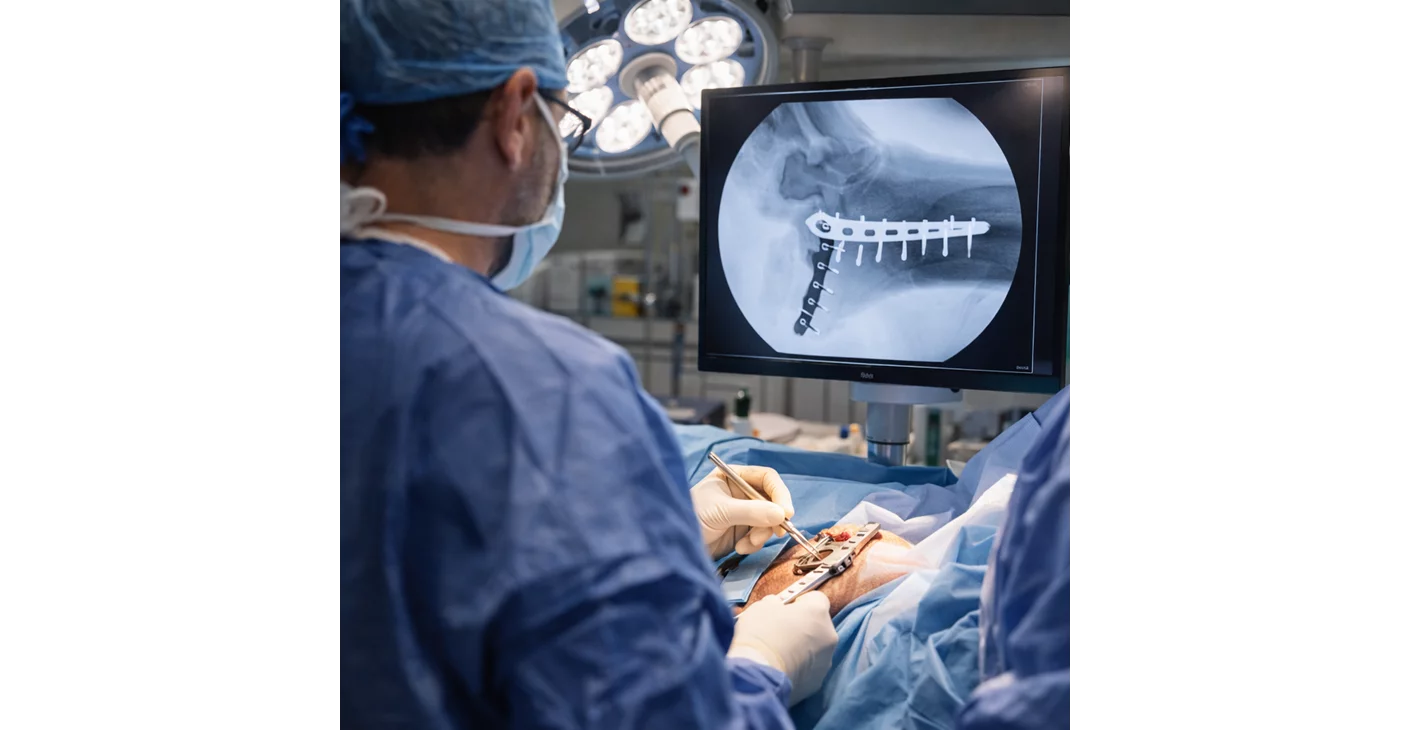
Plate Fixation
A 3.5 mm compression or locking plate secures each bone independently, normally with at least three bicortical screws on either side. Fluoroscopy checks the construct before closure.
DRUJ and Elbow Assessment
After radius fixation, the DRUJ is tested in supination. After ulna fixation, rotation confirms radial head reduction. Any remaining Galeazzi or Monteggia instability is treated before closure.
Closure and Splinting
Both wounds are closed in layers and protected in a forearm splint. Position depends on the fracture pattern, and the first physiotherapy instructions are provided before discharge.
Forearm Fracture Fixation Recovery Timeline in Dubai
Recovery protects the fixation while progressively restoring forearm rotation, wrist movement, grip strength and confident upper limb use.
Weeks 0 to 2
Wound Protection
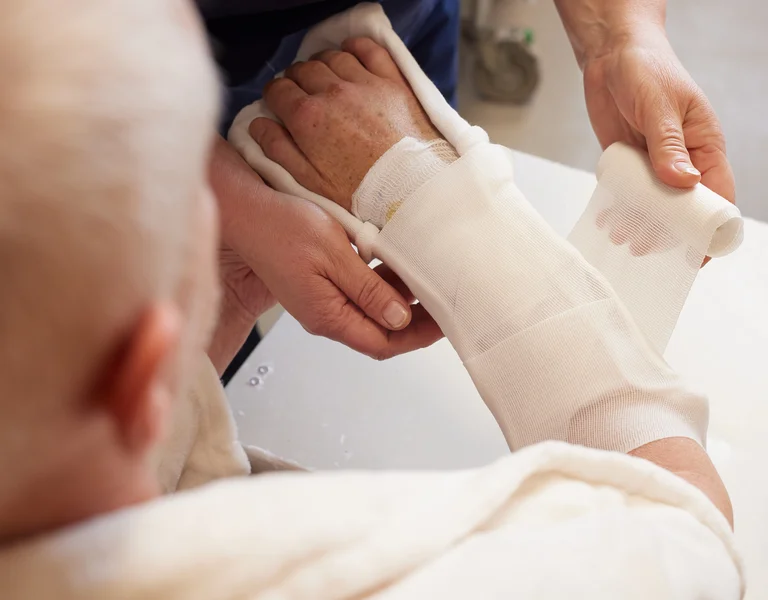
Protect the wounds and fixation while keeping the fingers, elbow and shoulder moving.
- Splint
- Protective forearm splint remains in place
- Movement
- Finger motion starts immediately, with elbow and shoulder use from day one
- Review
- Wounds and fixation are checked at approximately 2 weeks
Weeks 2 to 6
Early Forearm Motion
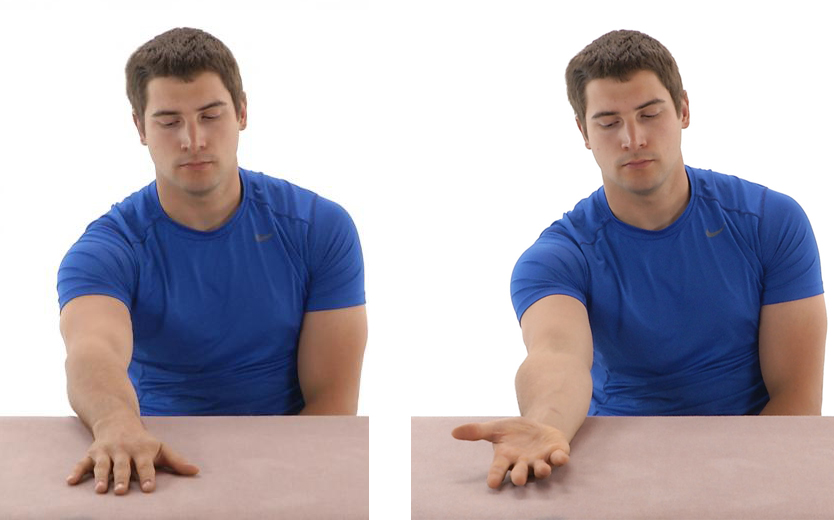
Supervised movement begins after splint removal, with rotation progressing inside a comfortable range.
- Rotation
- Active pronation and supination within the pain-free range
- Wrist
- Controlled flexion and extension exercises
- Goal
- Functional forearm rotation by approximately 6 weeks
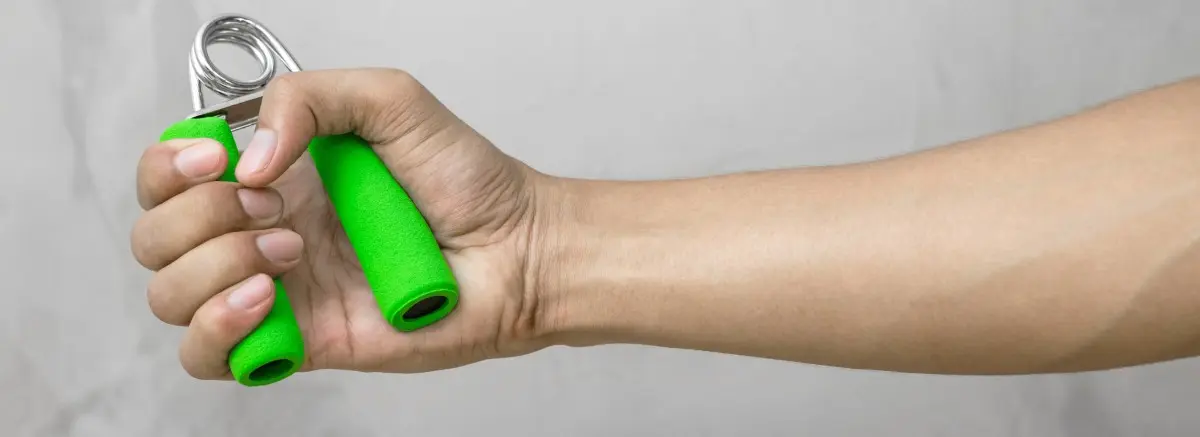
Weeks 6 to 12
Progressive Strengthening
Resistance is introduced after imaging confirms satisfactory healing and construct stability.
- Strength
- Progressive resistance for rotation and grip
- Imaging
- X-ray at 6 to 8 weeks checks callus and union progress
- Activity
- Return to light manual tasks as advised
Months 3 to 6
Return to Full Activity
Heavy work and sport resume only after radiological union and functional strength are confirmed.
- Work and sport
- Often resume at 4 to 6 months after confirmed union
- Final review
- Clinical and imaging assessment at approximately 6 months
- Implants
- Removal considered at 18 to 24 months only if symptomatic
Patient Outcomes: Forearm Fracture Fixation in Dubai
Three patients describe their recovery after specialist fixation of both-bone, Galeazzi and Monteggia forearm fractures.
I fractured both forearm bones in a motorcycle accident. Dr. Ali performed dual-plate ORIF in Dubai and I began forearm movement at 2 weeks. By 5 months I had regained full rotation and returned to work.
After my fall, Dr. Ali fixed the radius and checked the DRUJ during the same operation. The wrist remained stable after 4 weeks in a splint. At 4 months my rotation was normal and the wrist pain had resolved.
Dr. Ali plated my ulna after a road accident and the radial head reduced correctly. I began mobilisation at 10 days. By 5 months I had a functional elbow and forearm and returned to physical work without restriction.
Patient experiences are individual. Recovery time and outcomes vary with fracture severity, associated joint injury, healing and participation in rehabilitation.
Risks and Outcomes of Forearm Fracture Fixation in Dubai
Dr. Mohamed Ali explains procedure-specific risks, prevention strategies and realistic recovery expectations before surgery.
Radio-ulnar Synostosis
Abnormal bone can bridge the radius and ulna, restricting or eliminating forearm rotation. Risk is greater after high-energy injury, delayed surgery and severe soft-tissue damage.
Separate incisions and meticulous haemostasis help protect the interosseous space.
Non-union
Failure of the fracture to unite can cause persistent pain, deformity and implant failure. Open injury, bone loss, smoking and premature loading increase the risk.
Serial X-rays track healing; established non-union may require grafting and revision fixation.
Nerve Injury
The posterior interosseous nerve and radial artery require careful protection during exposure. Temporary nerve symptoms often recover over 3 to 6 months.
The volar Henry approach uses defined anatomical intervals to protect vulnerable structures.
Infection
Superficial infections may settle with antibiotics, while deep infection can require surgical debridement. Open fractures carry a higher risk than closed injuries.
Surgery is performed at DHA-licensed facilities using established infection-control protocols.
Why Choose Dr. Mohamed Ali for Forearm Fracture Fixation in Dubai
Successful fixation requires precise surgical exposure, stable plate constructs and intraoperative assessment of the wrist and elbow joints.
Fellowship-Trained Upper Limb Trauma Surgeon
Dr. Ali's training covers isolated shaft fractures, both-bone injuries and complex Galeazzi and Monteggia patterns, treating the forearm as one coupled mechanical unit.
DRUJ and Radiocapitellar Assessment
After fixation, wrist and elbow joint stability is checked under fluoroscopy. This identifies associated injuries that can otherwise cause chronic pain and restricted rotation.
DHA Licensed Facilities
Surgery is performed at DHA-regulated Dubai facilities with modern forearm plating systems, intraoperative fluoroscopy and coordinated post-operative physiotherapy.
Synostosis Prevention Protocol
Separate incisions, careful haemostasis and protection of the interosseous space are standard measures used to reduce radio-ulnar synostosis risk.
No Referral Required
Book directly without a GP or specialist referral. For an acute forearm fracture, call +971 50 254 4263. Consultations are available every day from 9 AM to 5 PM in Dubai.
Forearm Fracture in Dubai? Book a Specialist Assessment Today.
Book a consultation with Dr. Mohamed Ali in Dubai. He will review your X-rays, identify any associated joint injury and plan the most appropriate fixation. No referral required. Call +971 50 254 4263 or book online.
Related Surgical Procedures in Dubai
Elbow Fracture Fixation Dubai
Radial head, olecranon and distal humerus fracture fixation at DHA-licensed facilities in Dubai.
Arm Fracture Fixation Dubai
Humeral shaft fracture fixation and proximal humerus reconstruction in Dubai.
DRUJ Instability Surgery Dubai
Surgical stabilisation of the distal radioulnar joint for chronic instability and failed Galeazzi repair.
Forearm Fracture Fixation Available in Dubai, UAE
Dr. Mohamed Ali performs forearm fracture fixation at DHA-licensed facilities in Dubai, UAE. Patients from Abu Dhabi, Sharjah and the Northern Emirates travel to his Dubai practice for specialist radius, ulna and both-bone forearm fracture surgery. Direct booking is available without a referral.
Dubai
DHA-licensed facilities providing specialist fixation for radius, ulna, both-bone, Galeazzi and Monteggia fractures.
Direct booking · No referral requiredAbu Dhabi
Patients travel to Dubai for independent fracture review, surgical fixation and coordinated rehabilitation.
Radius · Ulna · Both-bone fracturesSharjah
Direct access to upper limb trauma assessment for displaced and complex forearm fracture patterns.
Assessment · Fixation · Follow-upNorthern Emirates
Specialist surgical care for forearm fractures and associated wrist or elbow joint injuries in Dubai.
Galeazzi · Monteggia · Open fracturesEverything you need to contact or visit the Dubai practice.
Searching for forearm fracture fixation near me or a forearm fracture specialist near me in the UAE? For acute fractures, call +971 50 254 4263 immediately.
Book a Direct ConsultationFrequently Asked Questions
Forearm Fracture Fixation in Dubai
How long does it take to recover from a forearm fracture?
Recovery from forearm fracture fixation in Dubai varies by pattern. Both-bone forearm fractures allow early movement at 2 weeks and return to full activities at 4 to 6 months. Galeazzi fractures require DRUJ protection for 4 to 6 weeks before full rotation resumes. Monteggia fractures allow early mobilisation after ulna fixation. All cases require structured physiotherapy for forearm rotation and grip recovery. Dr. Mohamed Ali provides a personalised timeline at your Dubai consultation.
Do forearm fractures always need surgery?
In adults, most forearm shaft fractures require surgical plate fixation. Even small degrees of angular malunion permanently reduce forearm rotation. Both-bone forearm fractures, Galeazzi fractures and Monteggia fractures always require surgery. Isolated minimally displaced ulna shaft fractures may be managed without surgery in selected cases. Dr. Mohamed Ali assesses each fracture individually at his DHA-licensed Dubai practice.
What is a Galeazzi fracture?
A Galeazzi fracture is a fracture of the radial shaft combined with dislocation of the distal radioulnar joint at the wrist. Surgery is always required. The radius is plated and the DRUJ is checked after fixation. If the DRUJ remains unstable, a temporary K-wire stabilises the joint for 4 to 6 weeks. Dr. Mohamed Ali performs Galeazzi fracture surgery at DHA-licensed facilities in Dubai.
Can you move your arm with a forearm fracture?
Most adult forearm shaft fractures produce significant pain and swelling that limit movement. If you have had a forearm injury and are unsure whether a fracture is present, seek specialist assessment urgently. Any forearm injury with pain, swelling and restricted rotation requires X-ray evaluation. Call +971 50 254 4263 to book an urgent assessment in Dubai.
How serious is a forearm fracture?
A forearm shaft fracture in an adult is a significant injury requiring surgical treatment in most cases. Malunion permanently reduces forearm rotation. Missed DRUJ injury in a Galeazzi fracture produces chronic wrist instability. Open fractures require urgent debridement. Dr. Mohamed Ali assesses all forearm fractures at his DHA-licensed Dubai practice, identifying associated injuries that must be treated at the same episode.
Do I need a referral for forearm fracture surgery in Dubai?
No referral is required. You can book a forearm fracture consultation with Dr. Mohamed Ali directly without a GP or specialist referral. For acute forearm fractures, call +971 50 254 4263 urgently. Consultations are available everyday from 9 AM to 5 PM in Dubai. If you are searching for forearm fracture fixation near me in the UAE, book directly online today.
Book Your Forearm Fracture Fixation Consultation in Dubai
Dr. Mohamed Ali performs forearm fracture fixation in Dubai, UAE. Fellowship-trained. DHA licensed. Both-bone ORIF, Galeazzi repair, Monteggia reconstruction, radius and ulna plating. No referral required.
+971 50 254 4263
Everyday: 9 AM – 5 PM
m.ali@dubaihand.com
Dubai, UAE
Thank you — your message was sent.
